Mothers of twins ‘have heavier single babies’

Single babies born to mothers of twins tend to be heavier, report scientists.

The report in the journal Biology Letters is based on a 40-year data set collected in The Gambia.

Mothers with twins were found to give birth to heavier babies, but the study found a similar trend even among single babies born before twins.

Twin pregnancies are risky for both mothers and offspring, and the study suggests heavier, healthier single children may offset those risks.

Worldwide only 13 in 1,000 babies are born a twin, although this rate is higher in developing countries.

Researchers interested in probing the twinning question further have had to rely on the few long-term data sets collected in parts of the world where birth rates are higher, and there are therefore more twinning events.

Evolutionary biologist Ian Rickard from the University of Sheffield in the UK, saw an opportunity to do just this when he learned of a long-term data set from The Gambia, which included not only birth weights of about 1,900 babies born to around 700 mothers, but also the number of twins.

Analysing all 40 years, Dr Rickard explained that he and his Gambian and London-based colleagues saw that women who produced twins gave birth to heavier non-twin babies.

Harvesting data

The exact differences, however, depended on when those single babies were born.

The Gambia experiences regular variations in food supply, from a “harvest season” between January and June, and a “hungry season” for the rest of the year.

Single babies born during the harvest season before twins were on average 226g heavier than those from non-twinned families; those born after the twins were 134g heavier.

However, single children born into twinned families in the hungry season showed no discernible difference in average weight from those of non-twinned families.

“We’ve known for quite a while that… if a [foetus] is exposed to a period of the year between about July and October during their third trimester, they tend to have lower birth weight,” said Dr Rickard.

The assumption is that the stress of food scarcity swamps the heavier-baby effect found in the harvest season.

Producing twins, Dr Rickard suggested, could be just a by-product of natural selection acting on birth weight.

However, he stressed the “importance of replicating this [finding] in another population to see if this pattern holds up”.

He suspects that a hormone called IGF, which has long been linked to birth weight in humans, could be responsible for this pattern.

IGF is known to influence the growth rate of foetuses, and is implicated in the “polyovulation” that leads to multiple births.

In cattle, IGF levels tend to be 1.5 times higher in the cows who give birth to twins, and in mice high levels of the hormone are linked to larger litters.

:: Read original here ::

Dyslexia makes voices hard to discern, study finds

People with dyslexia struggle to recognise familiar voices, scientists suggest.

The finding is the first tentative evidence that small sounds in the human voice that vary between people are difficult for dyslexics to hear.

Writing in the journal Science, the scientists say that many people could have some degree of “voice blindness”.

And by studying it, scientists hope to better understand how the human brain has evolved to recognise speech.

Humans rely on small sounds called phonemes to tell one person from another.

As we first try to form the word dog, for example, phonemes are the “duh”-“og”-“guh” sounds that our parents prompt us to make.

But as we master the ability to read, we become less reliant on recognising these sounds to read, and eventually stop noticing them.

Despite ignoring them, however, phonemes remain important for voice recognition.

The tiny inflections in the way people pronounce phonemes gives a listener cues to tell one voice from another.

Because people who suffer from dyslexia are known to struggle with phonemes when reading, a US-based team of scientists wondered whether they might also struggle hearing them in people’s voices.

Listen well

To investigate, the team grouped 30 people of similar age, education and IQ into two camps: those with and without a history of dyslexia.

The subjects then went through a training period to learn to associate 10 different voices – half speaking English and half speaking Chinese – with 10 computer-generated avatars.

The subjects were then later quizzed on how many of those voices they could match to the avatars.

Non-dyslexics outperformed people with a history of dyslexia by 40% when listening to English.

However, this advantage disappeared when the groups were listening to Chinese.

Dorothy Bishop from the University of Oxford thinks that this is because “when [they] are listening to Chinese, it is a level playing field, because no one has learned to hear [Chinese] phonemes”.

The researchers think that dyslexics don’t have as comprehensive a phoneme sound library in their heads, and so they struggle when they hear phonemes spoken by unfamiliar voices because their “reference copy” isn’t as well-defined.

“It is a very interesting result. The only thing that I would really like to see to convince me… is if they were to repeat the experiment using Jabberwocky.”

Using Jabberwocky, the nonsense poem by Lewis Carroll, would allow the researchers to determine whether the listeners identify who’s who from the meaning of what they are saying, or whether listeners are purely relying on the phonemes.

Dr Bishop speculated that non-dyslexics may be worse at extracting the meaning of the words, meaning they under perform in this task.

Understanding the mechanics of voice recognition is important, said the study’s lead author Tyler Perrachione from the Massachusetts Institute of Technology in Cambridge, US, because it allows a listener to pinpoint a familiar voice above the hubbub of a crowded room.

Mr Perrachione explained that very little is known about voice blindness, which is formally called phonagnosia.

“In reality, phonagnosia is probably much more common,” he explained, “but people who don’t recognise that voices sound different may not even realise they lack the ability to tell voices apart.”


:: Read original here ::

Age-related brain shrinking is unique to humans

The brains of our closest relatives, unlike our own, do not shrink with age.

The findings suggest that humans are more vulnerable than chimpanzees to age-related diseases because we live relatively longer.

Our longer lifespan is probably an adaptation to having bigger brains, the team suggests in their Proceedings of the National Academy of Sciences paper.

Old age, the results indicate, has evolved to help meet the demands of raising smarter babies.

As we age, our brains get lighter. By 80, the average human brain has lost 15% of its original weight.

People suffering with age-related dementias, such as Alzheimer’s, experience even more shrinkage.

This weight loss is associated with a decline in the delicate finger-like structures of neurons, and in the connections between them.

Alongside this slow decline in its fabric, the brain’s ability to process thoughts and memories and signal to the rest of the body seems to diminish.

Researchers know that certain areas of the brain seem to fare worse; the cerebral cortex, which is involved in higher order thinking, experiences more shrinkage than the cerebellum, which is in charge of motor control.

Yet despite the universality of ageing, scientists do not fully understand why our brains experience this continuous loss of grey matter with age.

Intriguingly, the brains of monkeys do not seem to undergo the same weight loss, raising the question of whether it is a distinctively human condition.

Now, a team of neuroscientists, anthropologists, and primatologists have pooled their expertise and datasets to reveal the answer.

Comparing magnetic resonance images from more than 80 healthy humans between the ages of 22 and 88 with those of a similar number of captive-bred chimps, the researchers found that chimps’ brains do not shrink with age.

The results suggest that the estimated 5-8 million years of evolutionary history that separate chimps from humans have made all the difference in the way that the species age.

It takes a village…

Anthropologist Chet Sherwood from George Washington University in Washington DC, who led the study, thinks that humans live longer to “pay for” their larger-brained children.

Humans live relatively long compared to other great apes. The majority of this extended life is post-menopausal, while chimps are reproductively viable right up to their death.

A human brain is three times the size of chimpanzee’s.

And it is not such a stretch, Dr Sherwood suggests, to conclude that grandparents’ extended lives are in an evolutionary sense there to relieve mothers from being solely responsible for raising their big-brained, energetically costly infants.

“I say this right now, as my seven year old daughter is being looked after by my mother,” he told BBC News.

“Because neurons cannot regenerate, aging, he thinks, is just the stress of living long enough to lend a helping hand to some relatives.”

“[The study] provides very good evidence that the patterns of brain ageing in humans are quite different from other animals,” commented neuroscientist Tom Preuss from Emory University in Atlanta, US, who was not involved in the research.

However, Dr Preuss was clear that these differences do not make other animals useless as models for studying age-related diseases.

Instead, the differences could help to explain why humans suffer more from these diseases than other animals seem to.

:: Read original here ::

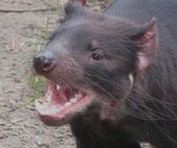
Tasmanian devil genome holds secret to survival

Scientists have sequenced the complete genomes of two Tasmanian devils in the hope of finding clues to preserving this highly endangered marsupial.

Devil populations have been decimated by a highly contagious facial cancer that is transferred when these aggressive animals bite each other.

The findings will help researchers select the best individuals to be kept in captivity for eventual re-release.

The research is outlined in Proceedings of the National Academy of Sciences.

The Tasmanian devil, Sarcophilus harrisii, gets its name from its high-pitch, blood-curdling squeal, and is renowned for fighting over access to animal carcases, which it grinds with the bone-crushing force of its jaws.

Candid cancer

In 1996, a wildlife photographer snapped an image of an animal in the far north-east of Tasmania with a peculiar growth on its face.

The growth, it turned out, was neither benign, nor isolated to this one individual, but was a highly contagious, fatal cancer that seemed to be spreading through the population at lightning speed.

By 2007, conservationists reported that Devil Facial Tumour Disease, DFTD, had wiped out more than 90% of devil populations in the north-east of Tasmania, and was spreading west.A strategy to save the devil from extinction was begun.

Now, an international team of genomicists is offering a helping hand.

The researchers took advantage of the latest technology to read the genetic sequence of two devils – an uninfected male called Cedric, and an infected female called Spirit – along with smaller segments of DNA from 175 other individuals.

The team hopes to use the genomes to pinpoint which individuals should be placed into “protective custody” to wait out the cancerous epidemic before being reintroduced.

From their analysis, the scientists predicted how best to capture as much genetic diversity among the individuals put aside for captive breeding, explained lead author Webb Miller, a genomicist from Pennsylvania State University, US.

He said that choosing individuals who were very genetically dissimilar should take priority over whether they were resistant to the cancer.

The devil you know

“It is a big step forward to actually get the genome sequence from this animal… the [world’s largest] remaining carnivorous marsupial,” said zoologist David Rollinson from the Natural History Museum, UK.

Getting two complete genomes was very valuable, said Dr Rollinson, but getting as many samples as they did, from as many different animals was “just the icing on the cake”.

Dr Rollinson thinks that a similar approach could be used to study and save other endangered animals.

The researchers also sequenced one of the five tumours from Spirit’s head for clues to why the Tasmanian devils fail to recognise the cancer as “non-self”, and destroy it before it takes hold.

Understanding what it is about the devil’s immune system that makes it so ineffectual at picking up the facial cancer will not only help treat those already infected, but will hold clues about whether the cancer can jump species.

“The greatest worry is that it will jump into another marsupial,” said cancer geneticist Elizabeth Murchison from the Welcome Trust Sanger Institute in Hinxton, UK.

The transmissible facial cancer

  • Devil Facial Tumour Disease (DFTD) is spread by biting during aggressive encounters
  • The living cancer cells exist as a contagious clone; highly unusual for a cancer. In fact, there is only one other transmissible cancer known, which infects dogs’ genitals
  • The devil’s immune system seems unable to detect the cancer
  • The disease forms tumours around the mouth interfering with feeding leading to death
  • The cancer originally arose in Schwann cells – cells which wrap themselves around nerve tissue
  • First seen in 1996, the cancer has since decimated devil populations

:: Read original here or listen to me talk about the results on the BBC’s Science in Action.

A rare he-she butterfly is born in London’s NHM

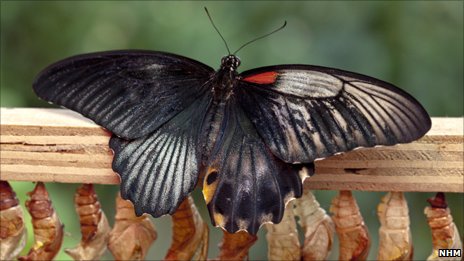
A half-male, half-female butterfly has hatched at London’s Natural History Museum.

A line down the insect’s middle marks the division between its male side and its more colourful female side.

Failure of the butterfly’s sex chromosomes to separate during fertilisation is behind this rare sexual chimera.

Once it has lived out its month-long life, the butterfly will join the museum’s collection.

Only 0.01% of hatching butterflies are gynandromorphs; the technical term for these strange asymmetrical creatures.

“So you can understand why I was bouncing off of the walls when I learned that… [it] had emerged in the puparium,” said butterfly enthusiast Luke Brown from London’s Natural History Museum.

Mr Brown built his first butterfly house when he was seven, and has hatched out over 300 thousand butterflies; this is only his third gynandromorph.

Half and half

It is not only the wings that are affected, he explained. The butterfly’s body is split in two, its sexual organs are half and half, and even its antennae are different lengths.

“It is a complete split; part-male, part-female… welded together inside,” he told the BBC.

The dual-sex butterfly is an example of a Great Mormon, Papilio memnon –a species that is native to Asia.

With a shortage of butterfly-specific gender neutral pronouns, the butterfly is being referred to as “it”, and is already middle-aged at three and a half week’s old.

So the public has only a narrow window of opportunity to see it alive.

Though rare, gynandromorphy isn’t unique to butterflies; individual crabs, lobsters, spiders and chickens have all been found with a mix of two sexes.

There are likely many more cases in the natural world, but sexual chimeras are more difficult to spot in animals where females and males look alike.

:: Read original here ::

Over-fished tuna in ‘hot water’, study finds

Two more species of tuna have been added to the Red List of Threatened Species.

They join the Southern bluefin tuna – listed as critically endangered.

The report, published in this week’s Science, is the first global assessment of this highly prized family of fish, which are at risk of being over-fished.

The World Conservation Union (IUCN) says there is a lack of resolve to protect against overexploitation driven by high prices.

Until this latest study, attempts to assess the health of scombrid and billfish populations, families of fish that include tuna and swordfish, have been carried out at a regional scale.

This study, which relies on the IUCN Red List criteria to judge the stocks’ health, took a more global approach.

Of the 61 species of fish assessed, seven were earmarked as either vulnerable, endangered or critically endangered. All suffer from over-fishing, habitat loss and pollution.

Along with the two species of tuna, two mackerel and two marlin joined the Red List.

The ‘sapphires of seafood’

Per kilo, bluefins are among the most expensive seafood in the world.

“All three bluefin tuna species are susceptible to collapse under continued excessive fishing pressure. The Southern bluefin has already essentially crashed, with little hope of recovery,” said one the the study’s authors Kent Carpenter the IUCN’s Marine Biodiversity manager.

Southern bluefin numbers have reached levels that are one twentieth of those recorded before industrial fishing began.

Atlantic bluefins have probably gone the same way, add the authors, while bigeye tuna is labelled “vulnerable”.

“Tunas are highly migratory fish, swimming across ocean basins and between the waters of various countries during their lifetimes. Conserving them requires regional and global co-operation,” commented Susan Lieberman, director of international policy with the Pew Environment Group in a statement.

What is more, tuna’s restricted spawning grounds make them exceptionally susceptible to collapse if over-fishing continues, reports the international team of scientists.

And tuna’s long lifespan means it would take their population several years to recover if fishing stopped altogether.

Pew’s Dr Lieberman adds: “The IUCN Red List assessment reinforces that it is time for governments to live up to their responsibilities.”

The report comes days before the tuna regional fisheries management organizations (RFMOs) assemble in in La Jolla, California for the Kobe III meeting.

Read original here

And a little extra comment on the story.

Worms’ sex life yields advantage over parasites

Sex gives worms the power to fight off parasites, report researchers this week in the journal Science.

Worms forced to reproduce asexually succumbed to a nasty bacterial infection and died.

The researchers say the results are the most convincing evidence to date for a key theory in evolutionary biology.

The theory holds that sex evolved because it lets organisms reshuffle their genes into new combinations to stay a step ahead of parasites.

Sex has long troubled evolutionary biologists.

Reproducing asexually – where organisms clone themselves – makes much more sense; there is no need for an organism to search and seduce a mate, fight off competitors, or risk contracting a sexually transmitted disease.

What is more, given that an organism has survived long enough to reproduce, it is likely to have a first-rate set of genes under its pelt.

Why run the risk of diluting these good genes with potentially poorer ones from another organism?

And yet sex exists; the vast majority of animals and plants reproduce this way.

Fluctuating futures

Parasites, many biologists believe, might be the answer.

Parasites create a situation where, in spite of the disadvantages of sex, it is good for an organism to reshuffle its genome with that of another.

This reshuffling creates offspring with new gene combinations that are potentially better than older combinations at resisting a parasite’s advances.

The genetic “arms race” between a parasite and its host is often refered to as an example of Red Queen-style interaction – a term coined by biologist Leigh Van Valen who summoned the image of the constantly running Red Queen from Lewis Caroll’s Through the Looking-Glass.

The analogy seemed to him fitting for describing how species must continually evolve to keep up with each other.

But despite the theory’s popularity, there has been little hard evidence for it.

Out in the field, biologists have noted that organisms are more likely to reproduce sexually when there are more parasites loping around in their vicinity.

What has been missing is a direct manipulation to organisms’ sex lives to test if it makes them more or less resistant to parasites.

Direct evidence

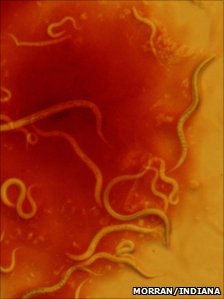
Now researchers working at Indiana University in the US have used the round worm Caenorhabditis elegans to do just this.

The team engineered two types of worms – some that could only reproduce by having sex, and some that could only clone themselves.

The researchers watched the worms gorge themselves on a lawn of a nasty bacterium, Serratia marcescens, which invades the worms’ guts and from there multiplies into every crevice of their body, killing the worms from the inside.

Across five different populations, worms that reproduced sexually fared well over the 20 generations, while all animals that cloned themselves died quickly.

Testing theory

“What is really beautiful about these lab systems is that you can manipulate the system and show that [the theory] can work,” said evolutionary biologist Aneil Agrawal from the University of Toronto in Canada.

Dr Agrawal described the experiment as “elegant” because it allowed the researchers to demonstrate that it was not simply the presence of the parasite that spelled the end for the cloners, but the presence of a parasite that had co-evolved alongside the worms.

To do this, the team created two treatments: one used bacteria from an original stock kept in the freezer, and the other used bacteria that had lived alongside the worms for many generations and so had adapted along with them.

Clonally doomed

In essence, “the bacteria got more and more infective, but the [clonal worms] did not get more and more resistant, and that is why they went extinct,” explained lead author Levi Morran, an evolutionary biologist from University of Indiana in the US.

“I am really excited about this; I think this is really cool,” Dr Agrawal told BBC News.

“Whether this is actually happening in nature is another thing; we can’t know that from a lab system,” he explained.

But he adds that as a first step it is important to demonstrate that under conditions where you expect sex to alleviate the effects of parasites, it does.

:: Read original here ::

Dinosaurs were animal world’s top bone heads

Scientists have compared a dinosaur with several modern-day animals to settle who wins the heavy-weight head-butting title.

The new findings confirm that the ancient bipedal dinosaur Stegoceras could knock out any of today’s top head-butters.

Stegoceras probably used their domed skulls to ram each other over access to fertile females.

The hard-hitting research was published in the journal PLoS ONE.

Stegoceras was a member of the leaf-eating genus Pachycephalosauria that roamed the Earth around 70 million years ago.

The goat-sized dinosaur supported a 7.5cm (~3 inches) thick bony skull, which some palaeontologists believe acted as a shock-absorber when these animals ran at each other.

Big hitters

However, images of the insides of Stegoceras‘ fossilised skull, which reveal two layers of dense bone that encase a spongy sinus held apart by tiny struts, has led some scientists to doubt this interpretation.

Hoping to clear up the controversy, biomedical engineer Dr Eric Snively wandered down the corridor at the University of Calgary in Alberta, Canada to enlist the help of colleague Dr Jessica Theodor, a vertebrate palaeontologist.

The duo performed computer tomographic (CT) scans on the skulls of Stegoceras, along with a variety of modern animals, and used these bone density measurements to create 3D models of the animals’ heads.

The team was then able to exert virtual stresses to test how the different skulls held up.

Compared to some of today’s big hitters, such as the Northern American bighorn sheep, the Arctic musk ox and African duiker, Stegoceras ‘ head was able to withstand the most stress.

“The argument that they couldn’t withstand the forces of head-butting seems to have been refuted by this evidence,” said Dr Theodor.

Crushing collisions

Dr Snively explained that if two animals ran at each other with a combined speed of 6.7 metres (22 feet) per second, which he estimates to be a realistic speed, Stegoceras‘ dome-head would have had to withstand an impact of over 13,000 Newtons (2,918 pounds-force).

“In human terms, that’s like balancing a Ford Focus on your head,” Dr Snively told BBC News.

“Even at these forces, only a few struts of bone might break; these would heal easily,” he said.

Offering further protection from these crushing collisions, Stegoceras‘ head was covered by a layer of keratin, the material nails are made from, and articulations between the vertebrae would have let the “backbone scrunch up like an accordion”, explained Dr Snively.

:: Read original here ::

Researchers switch on genes with blue pulse

Scientists have developed a technique that could be used to deliver precise doses of hormones to people who don’t make them naturally.

To do this, they rewired kidney cells with light-sensitive molecules from the eye, they reported in the journal Science.

When pulsed with blue light, these cells churned out proteins on demand.

Ultimately, this technique could avoid the need for people with diabetes to inject themselves regularly.

“When I speak to diabetes patients they say that if you could take away always having to inject themselves it would really increase their quality of life,” said lead author Martin Fussenegger, a bioengineer of the Swiss Federal Institute of Technology, Zurich.

Dr Fussenegger thought he saw a solution in his own field of optogenetics. Optogenetics, as the name suggests, uses light to control the behaviour cells.

To get a cell to respond to light you first have to rejigger it so it has a light-sensitive molecule on its surface. Dr Fussenegger coaxed kidney cells to express melanopsin, a molecule usually found in animals’ eyes.

Blue genes

He then placed these cells into diabetic mice. Along with the cells he placed an optic fibre, down which he could pulse blue light to expose the cells at his command.

In the dark, these cells behaved as usual; In the light, however, genes in the cell were switched on and the cell pumped out a protein required for the breakdown of sugars in the blood, helping the mice to control their glucose levels.

He hopes that cells like these could ultimately be implanted into people, and exposed to light – either through the skin or down a optic fibre – to release proteins that would help treat diabetes.

The new technique is a proof of principle. He told BBC News that it was not limited to treating diabetes; this technology could be usedto switch on genes to produce many different proteins in people who do not make them naturally, or are not making enough of them to be healthy.

Light switch

“I think this is a phenomenal research tool,” said James Collins, a synthetic biologist at Howard Hughes Medical Institute, Maryland, US, who was not involved in the work.

Dr Collins explained that as we move into an age of regenerative medicine, and begin to think of how we use stem cells to produce different tissues in the body, one of the challenges will be to work out which genes are needed to produce certain tissues and cells.

This new technique allows researchers to switch genes on and off to determine which are essential to make a specific tissues.

:: Read original here ::