An Early Warning Sign for Ecosystem Collapse?

The surprising strength and location of last month’s Fukushima earthquake highlighted how poorly seismologists can predict when the ground is about to shake cataclysmically. Unfortunately, ecologists can’t do much better at forecasting when an ecosystem is about to collapse or change dramatically. But now a team of ecologists has shown that it is possible to detect early distress signals in a lake that foretell a major disruption to its ecology. If researchers could identify similar signals in other ecosystems, they might one day predict, and perhaps even prevent, ecological meltdowns.

The collapse of the Atlantic cod fishery in the early 1990s saw the most abundant fish in the North Atlantic disappear due to overfishing. Such events are becoming increasingly common as humans overfish, overgraze, and alter the climate. Connections between predators and prey—often described as a food web—become destabilized. This leaves ecosystems vulnerable to dramatic changes, such as when a single species, like certain algae, grows out of control and forms toxic blooms, like the red tides common off the coast of Florida and Mexico. In theory, learning to detect the precursors of environmental distress could help raise the alarm before any damage is irreversible. But while that’s a nice idea on paper, no one has shown that it is possible in real ecosystems.

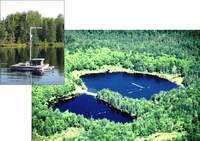
Now, in the first study of its kind, researchers have pinpointed early warning signs for the disruption of a food web in a lake. By gradually introducing a large fish species—the largemouth bass—into a Wisconsin lake dominated by smaller algae-eating fish, a team of ecologists pushed the aquatic ecosystem to a critical limit where the largemouth bass came to dominate the food web. The researchers had carefully monitored the lake throughout the whole experiment, using a buoy that measures chemical and physical vital signs of the lake every 5 minutes.

Combining these measurements with estimates of the populations of algae, zooplankton, and fish taken from regular net catches, the researchers report that they detected unusual oscillations in the amount of algae in the lake more than a year before the lake’s food web shifted. They say these oscillations are likely due to changes in the feeding behavior of the smaller fish that result from the presence of the introduced predators.

“All of a sudden the places that were once safe [for the zooplankton-eating fish] are dangerous,” says study co-author and ecologist Stephen Carpenter of the University of Wisconsin, Madison. Because the smaller fish shifted to shallow waters where bass threaten them less, he explains, the algae that inhabit the more open waters of the lake were free of their predators and their populations fluctuate more. Carpenter and his colleagues report online today inScience that these fluctuations were a warning that the lake’s food web is changing.

They believe that the fluctuations in species abundance may herald an overall transformation of the lake ecosystem. “The reason that there is so much excitement about these early warning signals is that they are universal,” says lake ecologist Marten Scheffer of Wageningen University in the Netherlands. Many systems have tipping points, he explains, even the climate system. He adds that isolating these signals from the ecosystem is not only useful for predicting environmental catastrophes, but they can also be used to determine which habitats are most likely to respond to conservation, and so allow ecologists to direct their efforts.

The major challenge now for ecologists is isolating the appropriate signals in other ecosystem. Ecologist Robert Holt of the University of Florida in Gainesville explains that Carpenter and his team have worked on this lake system for many years, and thus they understand it intimately. Ecologists don’t understand most other ecosystems nearly as well, he says, and so may find it harder to pin down the appropriate early warning signals in other systems.

:: Read original here ::
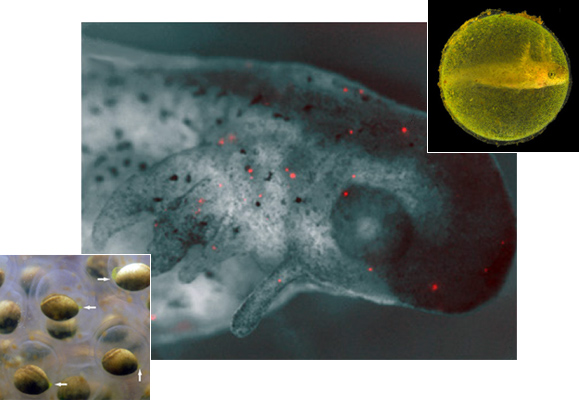
Green Eggs and Salamanders

It might sound like something out of a Dr. Seuss story, but biologists have long told tales of the green eggs of the spotted salamander. Ambystoma maculatum lays its brood in ponds each spring up and down North America. These marble-sized gelatinous sacs quickly turn green (bottom left and top right images) as photosynthesizing algae grow around the developing embryo and feast on its waste. In turn, the embryo enjoys the oxygen produced by the algae. Now scientists have discovered that the algae gets a little closer than they thought. Using long-exposure imaging, the researchers detected algal fluorescence (main image) inside the developing salamander. This is the first case of an algae living symbiotically within a vertebrate, the team reports online today in the Proceedings of National Academy of Sciences. How the photosynthesizing algae gets there, and how it survives inside the tissues and cells of this predominantly nocturnal amphibian is still baffling to scientists. But one thing’s for sure, the discovery means rewriting textbooks to add salamanders to a short list of organisms, including coral and bacteria, that form symbiotic relationships with plants.

:: Read original here ::

The Earliest Touchdown

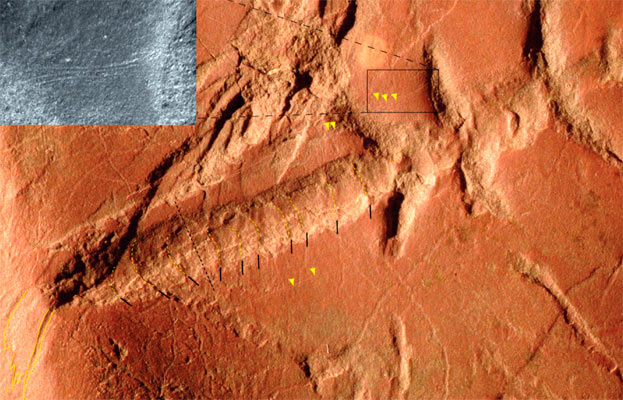
Three hundred million years ago, a flying insect skidded to a landing on a muddy patch of earth and preserved a 3.5-centimeter-long imprint for eternity. From the position of the legs, the curve of the abdomen, and the lack of wing marks, the researchers suspect that the imprint was made by an ancient mayfly that held its wings upright when at rest. Collected in southeastern Massachusetts, the fossil is the oldest known full-body impression of a flying insect, the team reports online today in the Proceedings of National Academy of Sciences. The ability of today’s insects to skim the surface of water is thought to be a modern invention. But the discovery of tiny drag marks (see inset) that suggest that mayflies likely slide before stopping is at least enough to prompt some paleontologists to keep an open mind on the matter.

:: Read original here ::

Researchers Grow Protoeye in Dish

It’s not quite Avatar, but a movie released today shows, in three dimensions, how a chaotic patch of cells grows into the beginnings of an eyeball. Even more impressive, this protoeye was grown in a laboratory dish. Scientists say the finding brings them closer to growing entire organs in the lab, including eyes that could replace those damaged by injury or disease.

In the past decade, researchers have made dramatic progress in understanding how eyes form. They have learned how to turn on and off essential genes and how to transform embryonic stem cells into retinal cells, which can be transplanted into mice to restore vision. But so far, growing an entire eyeball in the lab has eluded scientists, largely because they’ve been unable to recreate the “optic cup,” a chalice-shaped structure that becomes the back of the eye.

Now Yoshiki Sasai of the RIKEN Center for Developmental Biology in Kobe, Japan, and his colleagues have induced embryonic mouse stem cells to spontaneously form the optic cup in a dish. The key ingredient was a mixture of jellylike proteins, called Matrigel, which forms an enticing bed on which stem cells seem to prefer to lie before turning into the eye’s various structures.

In the movie, the cells—made to glow green—push out before inverting and forming two different layers: the first, the retinal cells, and the second, the neurons. This is the first demonstration that stem cells direct their own development in the eye, the team reports online today in Nature.

Knowing that stem cells can direct their own development is key if we want to grow organs without having to also grow the tissues that usually develop around them, says developmental biologist Jane Sowden of University College London, who was not involved in the study. She says that even though Sasai’s team hasn’t yet grown an entire eyeball in a dish, the work shows that it’s possible to grow specific eye structures, such as retinas, from stem cells in a great enough quantity that they could be used in therapy. If the researchers can get the technique to work with human stem cells, she says, it could help the one in 3000 people born with a form of blindness caused by damaged retinal cells and the many more who lose their sight because of age-related disease.

:: Read original  here ::

Now That’s a Big Number

Worried about having enough hard drive space to store all of your holiday pictures? Just be glad you don’t have to cope with the 9.57 zettabytes—that’s 9,570,000,000,000,000,000,000 bytes—of information that the world’s 27 million business computer servers process each year. If you divided 9.57 zettabytes among the 3.18 billion workers that make up today’s global labor force, then each person would receive around 3 terabytes of information per year. That’s enough to fill the largest external hard drive three times over. What’s most worrying is that this number will likely double every 2 years, according to researchers who presented their estimates at a conference for data storage professionals in the United States in Santa Clara, California, today. Might be time for a reformat.

:: Read original here ::

Sensing Organ Rejection

sensingorganrejection

Rejection hurts, but for organ transplant patients it’s more than an emotive issue—it can be a matter of life and death. Having waited months, sometimes years, for a donor and survived major surgery, transplant patients face an uphill battle to prevent their immune systems from rejecting their new organ. Now a new test in which a transplant patient’s blood is scanned for DNA from the donor organ can alert doctors if serious rejection has begun, allowing them to try to stop the process.

Approximately 40% of transplant patients experience at least one episode of acute rejection in the first year after they receive an organ. Catching any major immunological backlash early is key to minimizing its effects, especially because most rejection episodes are reversible with a large dose of immunosuppressant drugs. But patients typically must undergo regular biopsies of their new organ to monitor its health; the procedure is both painful and expensive, and biopsies also risk damaging the organ, explains cardiologist Hannah Valantine of Stanford University School of Medicine in Palo Alto, California. In 2009, Valantine developed a noninvasive rejection test that relies on monitoring a patient’s immune system. AlloMap became the first U.S Food and Drug Administration-approved test for heart transplants, but it still fails to catch about half of rejection events.

To capture the rest, Valantine recently headed back to the drawing board. This time she enlisted help from biophysicist Stephen Quake of Stanford. Together they designed a test that relies on the fact that a transplanted organ’s genome is distinct from that of its new host. The test monitors fragments of DNA released by the organ into the blood, when cells from the transplant tissue are naturally broken down. To validate this strategy, the researchers tried their test on stored blood plasma from organ transplant patients, some of whom had had confirmed rejection episodes. During a rejection event, the levels of circulating DNA from the donor organ go up, making up on average 3% of free DNA in the recipient’s blood rather than the typical 1%, the researchers report online today in the Proceedings of National Academy of Sciences.

Valantine hopes that this test can eliminate the need for regular biopsies as a means of rejection monitoring; patients often have one every month in the first year after a transplant. Instead, physicians would perform confirmation biopsies only if the DNA test results were positive. The new test can detect “very low levels of DNA to predict rejection,” Valantine says, making this approach more sensitive than the AlloMap test. If the test can alert doctors to rejection earlier, she notes, they can “tinker” with the levels of immunosuppressant drugs rather than go in with “a big-gun approach” that lowers the patient’s immune system so much that they are at risk of infection and cancer.

Bruce Rosengard, the surgical director of the cardiac transplantation program at Massachusetts General Hospital in Boston, is cautiously optimistic about the new test. “Organ rejection remains one of the primary obstacles to transplant success,” he says. “Anything that we can do to reduce the number of heart biopsies is a very positive development. … I think this approach will gain traction pretty quickly.”

Valantine hopes to have the new test available to doctors in a year’s time, adding that she sees no reason why it can’t be used to detect rejection of other transplanted organs.

:: Read original here ::

Monkeys Chew the Cud

Eating your greens can be grueling, especially if you are a monkey who dines on a high fiber diet. Some primates overcome their digestive dilemma by hosting microbes in their guts that help them breakdown the tougher leaves, much like cows do. Cows and other ruminants also maximize this symbiotic relationship by regurgitating and rechewing their stomach contents to get the most out of each meal. This behavior was considered unique to four-legged herbivores. Now researchers have witnessed proboscis monkeys that live in the mangroves and swamps of Borneo doing the same (see the video). This is the first evidence that primates ruminate, too, reports the team online today in Biology Letters, and gives us all something to chew over.

:: Read original here ::

The Oldest Buttercup Yet

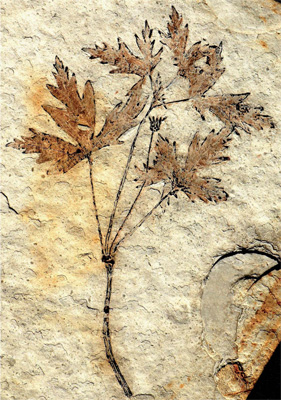
Darwin called the origin of flowering plants an “abominable mystery.” They appear in the fossil record and immediately grow abundant and varied, creating a problem for his theory of slow but continuous change. The unearthing of a new fossil in northeast China, described online today in Nature, could explain the apparent contradiction. The ancient flowering plant, Archaefructus liaoningensis, resembles a modern-day buttercup, with slender stems and three-lobed leaves. Its discovery pushes back the date of when flowering plants diversified to around 127 million years ago, during the early Cretaceous period. That’s a couple of million years earlier than Darwin had previously thought, suggesting that these ancient blooms had longer to evolve than he suspected.

:: Read original here ::

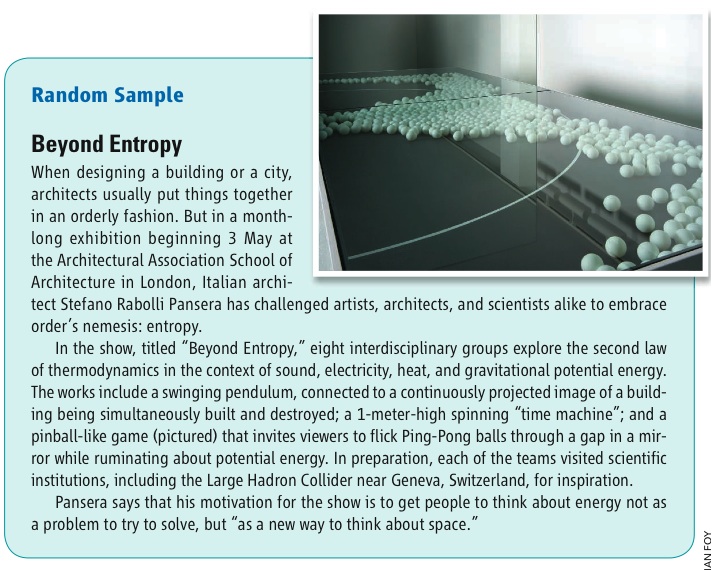
Beyond Entropy

:: Read original here ::