Images capture moment brain goes unconscious

For the first time researchers have monitored the brain as it slips into unconsciousness.

The new imaging method detects the waxing and waning of electrical activity in the brain moments after an anaesthetic injection is administered.

As the patient goes under, different parts of the brain seem to be “talking” to each other, a team told the European Anaesthesiology Congress in Amsterdam.

But they caution that more work is needed to understand what is going on.

The technique could ultimately help doctors pinpoint damage in the brains of people suffering from stroke and head injury.

“Our jaws just hit the ground,” said anaesthesiologist Professor Brian Pollard from Manchester Royal Infirmary on seeing the images for the first time.

“I can’t tell you the words we used as it wouldn’t be polite over the phone.”

Although regions of the brain seem to be communicating as “consciousness fades”, Professor Pollard cautions that it is early days and that he and his team from the University of Manchester still have many brain scans to analyse before they can say anything conclusive about what is happening.

The finding supports a theory that is championed by Professor Susan Greenfield, from the University of Oxford, that unconsciousness is a process by which different areas of the brain inhibit each other as the brain shuts down.

The new technique, called Functional Electrical Impedance Tomography by Evoke Response (fEITER), is more compact than other brain imaging techniques, such as functional magnetic resonance imaging (fMRI), and so is easily transported into the operating theatre.

It involves attaching tens of electrodes to the patient’s head, which send low electrical currents through the skull. The currents are interrupted by the brain’s tissues and electrical signals.

Professor Pollard explained that the brain’s structures should not change over a minute-long scan, and so any differences that he and his team see as the patient falls asleep must therefore be due to changes in their brain’s activity.

It is hoped that this technique could be used to learn about the nature of consciousness, but it is also likely to help doctors make headway in monitoring the health of a person’s grey matter after they have suffered a head injury or stroke.

:: Read original here ::

Climate to wreak havoc on food supply, predicts report

Areas where food supplies could be worst hit by climate change have been identified in a report.

Some areas in the tropics face famine because of failing food production, an international research group says.

The Climate Change, Agriculture and Food Security (CCAFS) predicts large parts of South Asia and sub-Saharan Africa will be worst affected.

Its report points out that hundreds of millions of people in these regions are already experiencing a food crisis.

“We are starting to see much more clearly where the effects of climate change on agriculture could intensify hunger and poverty,” said Patti Kristjanson, an agricultural economist with the CCAFS initiative that produced the report.

A leading climatologist told BBC News that agriculturalists had been slow to use global climate models to pinpoint regions most affected by rising temperatures.

This report is the first foray into the field by the CCAFS initiative. To assess how climate change will affect the world’s ability to feed itself, CCAFS set about finding hotspots of climate change and food insecurity.

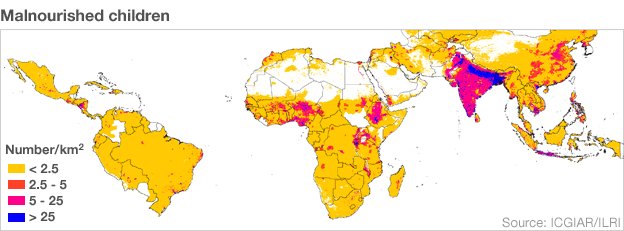
Focusing their search on the tropics, the researchers identified regions where populations are chronically malnourished and highly dependent on local food supplies.

Then, basing their analysis on the climate data amassed by the United Nations Intergovernmental Panel on Climate Change (IPCC), the team predicted which of these food-insecure regions are likely to experience the greatest shifts in temperature and precipitation over the next 40 years.

Mapping hunger

By overlaying the maps, the team was able to pinpoint which hungry regions of the tropics would suffer most.

With many areas in Africa predicted to become drier, countries such as South Africa which predominately farm maize have the option to shift to more drought resistant crops.

But for countries such as Niger, in western Africa, which already supports itself on very drought resistant crop varieties, like sorghum and millet, there is little room for manoeuvre, explains Bruce Campbell, the director of CCAFS.

“West Africa really stands out as problematic. Burkina Faso, Niger, Mali. They are already dependent on sorghum and millet.

“In many places in Africa you are really going to need [a] revolution in farming systems,” he says.

“We need everything we can lay our hands on,” said Sir Gordon Conway, professor of international development at Imperial College London.

Governments are aiming to limit the average increase in temperature to 2C by the end of the century, he explained. But if temperatures continue to follow their current trajectories “we are on for a 3-4C increase”, Sir Gordon explained.

If this was correct “things get very alarming”, the professor said.

Professor Martin Parry, a visiting professor at the Centre for Environmental Policy at Imperial College London, who co-chaired one of the working groups in the IPCC’s last climate assessment, responded to the report by saying he thought that CGIAR, the parent body to the CCAFS, had been slow to move into the field of climate change as a key area of research. But he added that this step was very welcome.

But he cautioned: “This gives us a better local picture of where the most vulnerable areas might be… but it doesn’t make strong enough connections between the changes in the weather and its impacts on yields.”

This made it difficult to plan for adaptations, Professor Parry told BBC News.

:: Read original here ::

Deepest-living land animal found

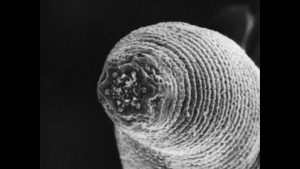
Worms have been found living at depths in the Earth where it was previously thought animals could not survive.

Discovered in South African mines, the roundworms can survive in the stifling 48C (118F) water that seeps between cracks 1.3km beneath the Earth’s crust.

The find has surprised scientists who, until now, believed only single-celled bacteria thrived at these depths.

Writing in the journal Nature, the team says this is the deepest-living “multi-cellular” organism known to science.

The researchers found two species of worm. One is a new species to science, which the scientists have named Halicephalobus mephisto after Faust’s Lord of the Underworld.

The other is a previously known roundworm known as Plectus aquatilis.

Until now, only single-celled organisms, like bacteria and fungi, have been recovered from kilometres beneath the Earth’s crust. The lack of oxygen is thought to stymie attempts by anything larger to make its home there.

But this has not stopped scientists looking.

Impossible depths

The Earth’s subterranean world is only accessible to researchers in a handful of places worldwide where ore-mining requires drilling to reach depths of more than 3km.

Taking advantage of two such sites – the Beatrix and Driefontein gold mines in South Africa – the international team of researchers placed filters over the mines’ bore-holes through which thousands of litres of groundwater pour.

From these samples they usually recover only bacteria; so the worms were a surprise.

“It scared the life out of me when I first saw them moving,” said geo-microbiologist Dr Tullis Onstott of Princeton University in New Jersey, US.”They look like black little swirly things,” he added.

These worms seem capable of surviving in very low levels of oxygen – at 1% of the levels found in most oceans, explained Dr Onstott.

But how did the worms get there?

The water in which the worms were found is between 3,000 and 10,000 years old, and so it is unlikely that the researchers brought the worms with them into the mines.

An ancient seep

The scientists, for now, believe that the animals originally came from the surface but got washed down into the cracks in the Earth’s crust by ancient rainwater.

Dr Gaeten Borgonie, a member of research team, explained that he thinks the animals look very much like the tiny worms that live in rotting fruit and soil at the surface, and probably descended from them.

Worms at the surface experience great extremes of temperature and can survive being frozen and thawed, dehydrated and re-hydrated, he told BBC News.

Dr Borgonie believes that worms already have some of the “attributes necessary” to survive at these great depths. So it wasn’t a surprise to him that the first multicellular organism to be found in the deep subsurface of the Earth was a worm.

The authors of the study expect to find other multicellular animals far beneath our planet’s surface, and are preparing to descend again to search for others.

:: Read original here ::

Mars ‘remains in embryonic state’

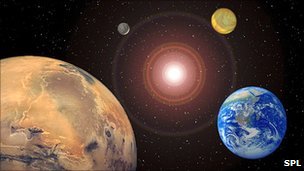
Mars formed in record time, growing to its present size in a mere three million years, more quickly than scientists previously thought.

Its rapid formation could explain why the Red Planet is about one tenth the mass of Earth.

The study supports a 20-year-old theory that Mars remained small because it avoided collisions with planetary building material.

The new finding is published in the journal Nature.

In our early Solar System, well before planets had formed, a frisbee-shaped cloud of gas and dust encircled the Sun.

Scientists believe that the planets grew from material pulled together by electrostatic charges – the same force that’s behind the “dust bunnies” under your bed.

These proto-planetary dust balls grew and grew until they formed what scientists term “embryo” planets.

These rocky masses were large enough to exert a considerable gravitational force on surrounding material, including other nascent planets.

Nudging each other with their gravitational fields, the embryos were often thrown from their regular orbits, sometimes into the path of another large rocky mass.

If collisions occurred, these nascent planets were either expelled from the Solar System or shattered into pieces. These pieces were often combined to form a larger planet. In fact, the Earth’s Moon is thought to be the result of an embryo planet colliding with our own planet.

By modelling this process, astro-physicists can determine the size of planets they expect to form at a given distance from the Sun. Mars is an outlier; it should have grown to around the size of the Earth, but remains about one-tenth its size.

Because of Mars’ small size, many scientists have long suspected that the Red Planet avoided the collisions that allowed other neighbouring planets to increase their girth.

Red Runt

By studying the chemical composition of meteorites, geochemist Dr Nicholas Dauphas of the University of Chicago in Illinois and Dr Ali Pourmand of the University of Miami in Florida joined forces to try to confirm this.

By measuring the concentration of elements Thorium and Hafnium in 44 space-rocks Dr Pourmand and Dauphas have come up with the most precise estimate of the time it took Mars to form.

Between 2 and 3 million years they suspect; short compared to the Earth, which is thought to have taken tens of millions of years to grow to its current size.

“We were pleasantly surprised because now we have precise evidence in support of the idea… that Mars is a stranded planetary embryo”, Dr Pourmand told BBC News.

He thinks that Mars was around more or less in its current size when the Earth was beginning to form.

Given this, Mars could not have experienced the same type of growth as the Earth and Venus, says Dr Pourmand.

It’s likely that Mars remains small because it deftly avoided colliding with other planets.

“The fact that Mars appears to have been left unscathed could just be down to luck,” says astrophysicist Dr Duncan Forgan of the University of Edinburgh, UK.

He explains that while it is unlikely that a planet could escape collisions for such long periods, statistically one expects it to happen from time to time.

When modelling planetary dynamics, researchers find it easier to predict what happens in general, he says, but it is much more difficult to determine what happens in specific solar systems, or in specific cases like Mars.

:: Read original here ::

Superbug Gene Found

superbuggene_lgA gene that causes bacteria to become resistant to antibiotics has been found in drinking water in New Delhi, India. NDM-1 is commonly found in Escherichia coli but can spread to other bacteria thanks to their ability to swap DNA. The gene confers resistance to antibiotics, including potent, last-resort drugs called carbapenems.

India’s warm temperatures, over-crowding, and poor sanitation are likely to blame for the gene’s spread into the main water system from bacteria in people’s guts, write Timothy Walsh of Cardiff University in the United Kingdom and colleagues in a paper published online last week in The Lancet Infectious Diseases. The team, who found the gene in two out of 50 tap water samples and 51 of 171 samples taken from puddles and streams in the capital, say the gene could spread farther afield when tourists drink local water supplies and then return home.

NDM-1 has already been found in U.K. hospitals in bacteria infecting people who had medical treatment in India and those admitted with “traveler’s tummy.” The new finding raises concerns that resistant genes, so far found mainly in gut flora, are becoming widespread in natural environments, where they are highly mobile.

:: Read original here ::

Safe Sex, Duck Style

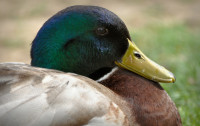
Male mallard ducks (Anas platyrhynchos) are famous for their long, spiraling genitalia. Now scientists have discovered that they have something else to crow about. Mixing duck ejaculate with a common bacteria, Escherichia coli, researchers have found that mallard duck semen kills bacteria. Semen from males with more colorful bills harbored the greatest antibacterial activity, killing up to three times more bacteria than those with duller bills, the team reports online today in Biology Letters. The finding suggests that female ducks may be drawn to brightly colored males not just because they’re more flashy, but because they spread fewer germs through sexual intercourse.

:: Read original here ::

Can States Sue on Greenhouse Gas as a ‘Nuisance’? High Court Asks

As the U.S. Environmental Protection Agency (EPA) is busy girding itself for a fight over new greenhouse gas emissions rules, the U.S. Supreme Court heard arguments today in a case on whether lawsuits over climate ought to be permitted.

At stake is whether greenhouse gas pollution may be considered a “nuisance” under U.S. law. The case stems from two 2004 federal lawsuits brought by seven states and several land-trust groups alleging that emissions from five major power companies could cause harm by contributing to global warming. Rising sea levels, loss of water in the Great Lakes, and reduced hydropower were among the injuries alleged by the plaintiffs; the lawsuits have since been combined, and two states have dropped out since the original suit was filed. The district court subsequently said in its decision that the case brought up a “political” question that the other branches of government, not the judicial branch, should consider, but an appeals court reversed that ruling. When the power companies appealed, the Supreme Court took the case.

In other pollution cases, the Supreme Court has supported suits claiming that pollution caused harm as a “nuisance” under common law, most often interpreted to prohibit noise and light pollution. The 80 minutes of occasionally spirited argument at the high court this morning focused on the two main issues in the greenhouse gas litigation: For the case to go forward, the plaintiffs must prove that the case has legal standing (they must show that the court is the right venue for resolving this dispute), and that the common law definition of nuisance can support suits over greenhouse gases. On the issue of standing, the court could rule that Congress or EPA is a more appropriate body to deal with pollution control.

The Obama Administration opposed the suing states in this case largely on grounds that they lack standing, marking a rare instance in which the Administration finds itself at odds with environmentalists on a major legal issue. (Environmentalists urged the states to try this legal strategy.) U.S. attorney Neal Katyal told the justices that the complexity of the issue suggests that the executive branch, namely EPA, is a better venue for controlling such an expansive type of pollution rather than the courts. “In the 222 years that this court has been sitting, it has never heard a case with so many potential perpetrators and so many potential victims,” he said in his opening remarks. “There are billions of emitters of greenhouse gasses on the planet and billions of potential victims as well.”

The attorneys for the power companies and the Obama Administration argued that the greenhouse gases case is fundamentally different from previous nuisance cases in which pollutants have played a central role. A landmark ruling by the Supreme Court in 1907, for example, found that a judge could stop a Tennessee copper company from polluting the Georgia environment under the nuisance doctrine. Such cases, Katyal said, “are essentially: A pollutes a river or something and hurts B.” But in the case of global warming pollution, he said, “A here is the world and B is the world, and that is such a difference in scale and scope to pose enormously difficult questions” about whether such suits should go forward.

If this case is allowed to proceed, asked the justices, should subsequent cases be limited to big polluters like the five targeted in this suit? “Your briefs talk a lot about how these are the five largest [U.S.] emissions producers, but I saw nothing in your theory to limit it to those five,” Justice Elena Kagan asked New York state attorney Barbara Underwood, who spoke on behalf of the six states in the suit. “Is there something that you think limits it to large emissions producers rather than anybody in the world?”

The states have argued that the larger the greenhouse gas emitter the stronger the connection linking pollution and potential harm. “These defendants,” Underwood said, speaking of the five polluters, “produce 650 million tons a year or 10% of U.S. emissions, and individually they produce amounts ranging from 1 to 3.5% of U.S. emissions.”

Those who challenged the states also suggested that courts would be ill-equipped to make the complex judgments that big regulatory agencies staffed with scientists and other experts make on a routine basis. Judges lack “the resources, the expertise” to be a “kind of super-EPA,” said Justice Ruth Bader Ginsburg.

But Underwood said courts could make such judgments—which could include determining how “substantial” an emitter must be to be found culpable—by relying on standards set by the agencies. She pointed to a cutoff set by EPA that limits regulated greenhouse gas polluters to those that emit 100,000 tons or more per year. “According to EPA’s own technical data, there would be at most a few thousand potential defendants.”

Because Justice Sonia Sotomayor recused herself—she sat on the panel that reviewed the issue in the appeals court—only eight justices heard the arguments. A 4-4 tie would mean litigation against the polluters could go forward, because that would leave in effect the earlier decision by the appeals court. While the tone of the questioning was largely skeptical toward the idea that such suits ought to go forward, divining a final ruling from the rough-and-tumble of oral argument can be difficult, especially because justices often ask tough questions of those they’re inclined to agree with—just to test their counterarguments. Eyes were squarely focused today on Justice Anthony Kennedy, often the swing judge when decisions are split 5-4 in favor of conservative decisions. Kennedy raised a concern that federal law, and EPA’s efforts to use that law, would necessarily “preempt” the common law. The court’s three liberal members, Ginsburg, Stephen Breyer, and Kagan, seemed skeptical on this issue, too.

At least one knowledgeable observer said a 4-4 tie was unlikely. “In short, this particular lawsuit seemed doomed, with the court’s biggest task figuring out how to say so without shutting the courthouse door entirely to such claims,” said longtime Supreme Court reporter Lyle Denniston.

:: Read original here ::
An Early Warning Sign for Ecosystem Collapse?

The surprising strength and location of last month’s Fukushima earthquake highlighted how poorly seismologists can predict when the ground is about to shake cataclysmically. Unfortunately, ecologists can’t do much better at forecasting when an ecosystem is about to collapse or change dramatically. But now a team of ecologists has shown that it is possible to detect early distress signals in a lake that foretell a major disruption to its ecology. If researchers could identify similar signals in other ecosystems, they might one day predict, and perhaps even prevent, ecological meltdowns.

The collapse of the Atlantic cod fishery in the early 1990s saw the most abundant fish in the North Atlantic disappear due to overfishing. Such events are becoming increasingly common as humans overfish, overgraze, and alter the climate. Connections between predators and prey—often described as a food web—become destabilized. This leaves ecosystems vulnerable to dramatic changes, such as when a single species, like certain algae, grows out of control and forms toxic blooms, like the red tides common off the coast of Florida and Mexico. In theory, learning to detect the precursors of environmental distress could help raise the alarm before any damage is irreversible. But while that’s a nice idea on paper, no one has shown that it is possible in real ecosystems.

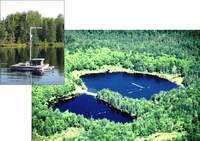
Now, in the first study of its kind, researchers have pinpointed early warning signs for the disruption of a food web in a lake. By gradually introducing a large fish species—the largemouth bass—into a Wisconsin lake dominated by smaller algae-eating fish, a team of ecologists pushed the aquatic ecosystem to a critical limit where the largemouth bass came to dominate the food web. The researchers had carefully monitored the lake throughout the whole experiment, using a buoy that measures chemical and physical vital signs of the lake every 5 minutes.

Combining these measurements with estimates of the populations of algae, zooplankton, and fish taken from regular net catches, the researchers report that they detected unusual oscillations in the amount of algae in the lake more than a year before the lake’s food web shifted. They say these oscillations are likely due to changes in the feeding behavior of the smaller fish that result from the presence of the introduced predators.

“All of a sudden the places that were once safe [for the zooplankton-eating fish] are dangerous,” says study co-author and ecologist Stephen Carpenter of the University of Wisconsin, Madison. Because the smaller fish shifted to shallow waters where bass threaten them less, he explains, the algae that inhabit the more open waters of the lake were free of their predators and their populations fluctuate more. Carpenter and his colleagues report online today inScience that these fluctuations were a warning that the lake’s food web is changing.

They believe that the fluctuations in species abundance may herald an overall transformation of the lake ecosystem. “The reason that there is so much excitement about these early warning signals is that they are universal,” says lake ecologist Marten Scheffer of Wageningen University in the Netherlands. Many systems have tipping points, he explains, even the climate system. He adds that isolating these signals from the ecosystem is not only useful for predicting environmental catastrophes, but they can also be used to determine which habitats are most likely to respond to conservation, and so allow ecologists to direct their efforts.

The major challenge now for ecologists is isolating the appropriate signals in other ecosystem. Ecologist Robert Holt of the University of Florida in Gainesville explains that Carpenter and his team have worked on this lake system for many years, and thus they understand it intimately. Ecologists don’t understand most other ecosystems nearly as well, he says, and so may find it harder to pin down the appropriate early warning signals in other systems.

:: Read original here ::

Green Eggs and Salamanders

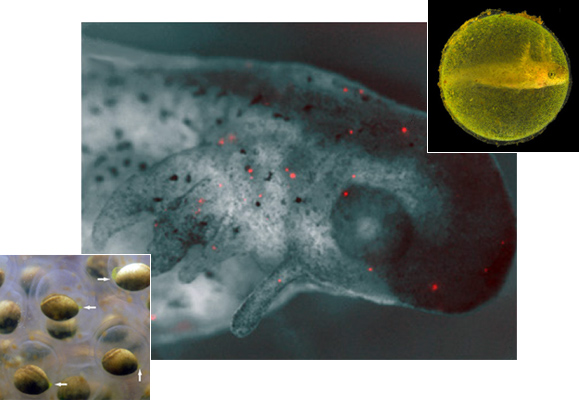
It might sound like something out of a Dr. Seuss story, but biologists have long told tales of the green eggs of the spotted salamander. Ambystoma maculatum lays its brood in ponds each spring up and down North America. These marble-sized gelatinous sacs quickly turn green (bottom left and top right images) as photosynthesizing algae grow around the developing embryo and feast on its waste. In turn, the embryo enjoys the oxygen produced by the algae. Now scientists have discovered that the algae gets a little closer than they thought. Using long-exposure imaging, the researchers detected algal fluorescence (main image) inside the developing salamander. This is the first case of an algae living symbiotically within a vertebrate, the team reports online today in the Proceedings of National Academy of Sciences. How the photosynthesizing algae gets there, and how it survives inside the tissues and cells of this predominantly nocturnal amphibian is still baffling to scientists. But one thing’s for sure, the discovery means rewriting textbooks to add salamanders to a short list of organisms, including coral and bacteria, that form symbiotic relationships with plants.

:: Read original here ::