The Secret of the Glowing Snail


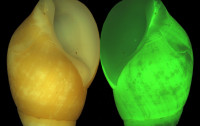
Talk about an inner glow. The marine snail, Hinea brasiliana, radiates green light to startle predators, so the snail can make a quick—or at least relatively quick—get away. But there’s a mystery to this bioluminescence: The snail’s body sports just a handful of glowing cells, yet its entire shell lights up. To shed light on the puzzle, researchers shed some light on the snails. They focused a tight beam of light through the shell’s opening, mimicking the light emitted from the animal’s cells, and found that the entire snail lit up. The trick appears to be that the mollusk’s shell scatters light. This allows the snail to turn a tiny glow into a much larger one, making it seem more formidable to predators. Understanding how the shell’s internal structure produces this luminosity could inspire lighting designs of the future, the team reports online today in the Proceedings of the Royal Society B.

:: Read original here ::

Poop Scoop

New baby? Feeling like you’re waist deep in dirty diapers? Forget diaper-collection services; just volunteer your infant for a poop study and researchers will take them off your hands for free. Dirty diapers, it seems, hold the key to measuring infant hormone levels.

Sex hormones, such as estrogen, are important for babies’ healthy development. But some endocrinologists worry that children are exposed to too much additional estrogen via soy formula, plant fertilizers, and even plastics, which could cause faster-than normal development and future problems with reproduction. However, few infants tolerate a frequent finger or heel prick, and so “very little is know about hormone levels in infants,” explains Michelle Lampl, an anthropologist at Emory University in Atlanta.

Diapers, however, can be collected frequently and over a long period of time, perfect for a
longitudinal study. Practicing on eight to 10 diapers collected from each of 32 largely breast-fed
infants over 6 months, Lampl’s group perfected a technique for extracting hormone levels from the
poop, they reported online last month in Frontiers in Systems Biology.

They also perfected their diaper-collection technique. “It took years to fi nd the right nappy
and work out how you get the diaper fresh from the home to the lab,” says Lampl. The secret: a
cotton diaper, a Ziploc bag, and an ice pack.

:: Read original here ::

Sleepy Bees Lose Their Rhythm

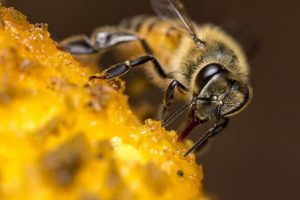
Sleep deprived and having trouble communicating? You aren’t alone. Drowsy honey bees (Apis mellifera) are incoherent, too, researchers report online today in the Proceedings of the National Academy of Sciences. Every morning, the bees set off on their daily foraging trips and return to the nest to perform a waggle dance. The angle of the bee’s body relative to the sun indicates the direction its comrades must fly in to find the good flowers, and the duration of its dance tells how far away they are. Sleep-deprived bees—kept up all night by researchers agitating them—made more errors when communicating the direction of the flower than did well-rested bees; at least until they had caught up on their sleep. Experiments to demonstrate whether bee insomnia is bad for the colony’s survival are underway; until the results are in, worker bees are advised to be tucked up in a hive, with a hot cup of nectar by 9 p.m.

:: Read original here ::

Whistling Caterpillars Shake Off Predators

When in danger, whistle. It works for the walnut sphinx caterpillar (Amorpha juglandis). The fat, juicy larvae of butterflies and moths tend to be experts at predator avoidance, using camouflage, rolling themselves in leaves, and even flicking their own poop to discourage birds, frogs, and small mammals from eating them. Whistling is just another string in their bow, researchers report online this week in The Journal of Experimental Biology. When the team used forceps to simulate the peck of a bird’s beak, the caterpillars forced air through the small holes on either side of their body—normally used for breathing—to produce a high-pitched whistle. When yellow warblers heard the noise, these natural enemies of the caterpillars hesitated, jumped back, or flew off. The sound may have startled them, or perhaps they found the tune indigestible.

:: Read original here ::

How to Feed a 180-Ton Whale

feed180tonwhale

For the blue whale, feeding is an Olympic event. The largest animal on Earth dives 500 meters at speeds of up to 3 meters per second, U-turns toward the surface, and then opens its colossal mouth to scoop up clouds of krill and filter them from the water with its brushlike teeth. A new study reveals that this massive energy expenditure is worth it. Although the whales are feasting on some of the smallest creatures on the planet, the dive fills them with enough sustenance to survive.

To understand the energetics of the blue whale’s feeding behavior, Robert Shadwick, a biomechanic at the University of British Columbia in Canada, and colleagues analyzed data collected from digital tags suctioned-cupped to the whales’ back. The tags, which travel with the animal on its descent to the clouds of shrimplike krill, measure the animal’s speed, depth, orientation and the number of times it beats its tail; they then pop off and float to the surface, ready to be retrieved by pursuing biologists. Combining data from these tags with measurements of whale jaws from museum specimens, the team modeled the drag experienced by the whale as it performs its complex underwater acrobatics.

The whales use about 63,000 kilojoules of energy on each dive, the researchers report online today in The Journal of Experimental Biology. But they also eat about 1260 kilograms of krill, as calculated from the average number of krill present in the 80 metric tons of water they gulp. And that provides the whales with about 100 times more energy from the tiny creatures than they spend capturing them.

Blue whales need that extra energy because they devote such a small proportion of their lives to feeding, says Ann Pabst, a functional morphologist at the University of North Carolina, Wilmington, who was not involved with the study. She notes that the animals spend many months either migrating to and from feeding grounds or reproducing, and during these periods they must survive off their fat reserves.

Pabst adds that the new study was possible only because of new tagging technologies, which were developed by the U.S. Navy to measure pressure deep in the ocean. The tags provide so much information that “we can almost visualize what is going on at [these] depths,” she says.

The researchers hope the work aids conservation efforts. Due in part to increased human consumption of krill as fish stocks run low, blue whale numbers are only 3% of what they were in the 1800s. The data could help conservationists make a stronger argument for how much krill the whales need to survive.

:: Read original here ::

Sharks Chew Off More Than They Can Bite

Teenage great white sharks might look all grown up, but they don’t have the awesome bite of a fully grown adult, researchers report online today in the Journal of Biomechanics. The team built a computer model based on measurements taken of the head of a young great white shark and its cousin, the sand tiger shark (seen here chomping down on a bait fish). Based on the structure of the sharks’ cartilage and muscle, the model indicates that the jaws of young great whites haven’t fully stiffened. This means that, although their gape is wide enough, the sharks can’t feast on the flesh of seals and other large mammals without damaging their jaws. The researchers hope the work helps conservation biologists better understand the sharks’ feeding behavior and protect their prey species.

See the movie of the biting shark.

:: Read original  here ::

Odor Exposure in the Womb Primes the Palate

Moms, want your children to eat their greens? Then you have to eat them, too, at least while you’re pregnant. Researchers have found that offspring of mouse mothers fed a diet enhanced with cherry and mint flavors during pregnancy continued to prefer these flavors into adulthood, while mice from mothers fed on a bland diet had no food preference. The rodents with a penchant for mint-cherry food developed larger glomeruli, the region of the brain responsible for processing odor—the first evidence that exposure to odors in the womb alters the way the brain develops. From the fetus’ point of view, this is a good evolutionary strategy; eat the foods that your mother ate because they are probably safe. It is likely that all mammals, including humans, develop their sense of taste in this same way, the researchers report online today in the Proceedings of the Royal Society B, so expectant moms, be careful the next time you have a hankering for anchovies with chocolate sauce.

:: Read original here ::

The Curious Case of the Backwardly Aging Mouse

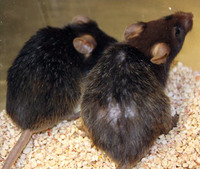
In F. Scott Fitzgerald’s short story, “The Curious Case of Benjamin Button,” an old man gets younger with each passing day, a fantastic concept recently brought to life on film by Brad Pitt. In a lab in Boston, a research team has used genetic engineering to accomplish something similarly curious, turning frail-looking mice into younger versions of themselves by stimulating the regeneration of certain tissues. The study helps explain why certain organs and tissues break down with age and, researchers say, offers hope that one day such age-related deterioration can be thwarted and even reversed.

As we age, many of our cells stop dividing. Our organs, no longer able to rejuvenate themselves, slowly fail. Scientists don’t fully understand what triggers this, but many researchers suspect the gradual shrinking of telomeres, the protective DNA caps on the end of chromosomes. A little bit of telomere is lost each time a cell divides, and telomerase, the enzyme that maintains caps, isn’t typically active in adult tissues. Another piece of evidence: People with longer telomeres tend to live longer, healthier lives, whereas those with shorter telomeres suffer more from age-related diseases, such as diabetes, Alzheimer’s, and heart disease.

Several years ago, Ronald DePinho, molecular biologist and director of the Belfer Institute of the Dana-Farber Cancer Institute, and colleagues at Harvard Medical School in Boston genetically engineered mice to lack a working copy of the telomerase gene. The animals died at about 6 months—that’s young for mice, which usually live until they are about 3 years old—and seemed to age prematurely. At an early age, their livers and spleens withered, their brains shrank, and they became infertile. By early adulthood, these mice exhibited many of the maladies seen in 80-year-old humans.

DePinho says he wondered what would happen to the aging process in these mice if they suddenly began making telomerase again. “Would [we] slow it, stabilize it, or would we reverse it?” He and his colleagues genetically engineered a new batch of mice with the same infirmity, but this time they added back a telomerase gene that became active only when the mice received a certain drug. The researchers kept the gene off during development and let these mice prematurely age, as the previous ones had. But then at 6 months, the team switched on the telomerase gene.

The burst of telomerase production spurred almost total recovery. The rodents became fertile, their livers and spleens increased in size, and new neurons appeared in their brains, the researchers reported online yesterday in Nature.

The ability to reverse age deterioration in the mutant mice indicates that the cells that divide to replenish tissues don’t simply die when their telomere clock expires, says DePinho. They apparently persist in a dormant state from which they can be revived. “One could imagine applying this approach to humans,” he says, focusing the therapy on specific tissue types such as the liver, where telomerase is thought to play an important role in regeneration after damage by hepatitis, parasitic infection, and alcoholism.

K. Lenhard Rudolph, who studies stem cell aging at the University of Ulm in Germany, says that the results are encouraging for people with diseases that cause accelerated aging, like progeria, because the mice in this study were rescued despite already suffering from the effects of chronic disease. “It is a proof of principle that telomeres are at work here.”

Drug companies and researchers are seeking ways to restore, protect, or extend a person’s telomeres, but the jury is still out on whether such interventions can slow the symptoms of aging, let alone reverse them. Telomere investigator Maria Blasco of the Spanish National Cancer Research Center in Madrid cautions that DePinho’s experiment shouldn’t raise people’s expectations of antiaging therapies just yet. “This study uses genetically modified mice,” she says. “What remains a very important question in the field is can you delay aging in a normal mouse?”

DePinho agrees with those concerns. He also warns that his approach has potential drawbacks, as increasing telomerase activity beyond its natural levels can cause cancer. Still, that may not be an insurmountable problem if telomerase levels can be carefully controlled. DePinho notes that the mice in his study, whose telomerase activity was returned to a natural level, didn’t develop tumors.

:: Read original here ::
U.K. Opens New Visa Route for Foreign Scientists, But May Still Curtail Their Number

The United Kingdom has finally begun revealing some of the details of its new immigration policies, although the information provided yesterday has done little to satisfy anxious universities, which are worried that their ability to hire foreign scientists will be greatly impeded.

In a statement to the House of Commons, the U.K.’s home secretary, Theresa May, described a new annual limit on the number of immigrants allowed from non-European Union countries. It will be set at 21,700—that’s a reduction from 28,000, which was the number of non-E.U. people who entered in 2009 under the immigration pathways known as skilled (Tier 2) and highly-skilled (Tier 1) workers. The government’s policy will include an amendment to Tier 1 that lets in 1000 of the 21,700 people under a new “exceptional talent” scheme; the government said this will apply to scientists, academics, and artists, although May provided no details on how people would qualify.

The new immigration plans will allow “Britain to remain competitive in the international jobs market, while ensuring migrant labor is not used as a substitute for those already looking for work in the U.K.”, May told members of the House of Commons.

onthly Tier 1 and Tier 2 visa allocations to universities introduced by the new U.K. government after it took power in May. Wendy Piatt, director general of the Russell Group, a collection of the U.K.’s largest research universities, said that it is unclear whether the numbers revealed yesterday are an improvement on the temporary caps, which the Russell Group viewed as limiting the U.K.’s ability to compete in the global market for academic talent. The University of Cambridge, a Russell group member, also issued a statement protesting May’s announcement:

The University of Cambridge cannot keep its place in the world rankings if it is prevented from recruiting the brightest and the best-regardless of nationality. The Government’s current visa quota proposals threaten our ability to recruit both the academic leaders of today and the exceptional young talent from which will grow the Nobel Prize winners of tomorrow.

The higher education lobbying group Universities UK had pushed hard to influence the government’s new policy and its chief executive, Nicola Dandridge, issued some modest praise for May’s plan, saying in a statement:

It is good that the government has listened to the arguments put forward by the research community about the need to ensure an appropriate route for people with exceptional talent in science and academia to enter the UK through the creation of a new route within Tier 1.

However, Dandridge expressed concern about how the government plans to define “exceptional talent,” pointing out that talent is difficult to measure. Dandridge says that her organization is keen to further discuss the immigration proposals with the government to clarify the details.

Imran Khan, director of the advocacy group Campaign for Science & Engineering (CaSE), echoed such concerns in a statement:

So far we’ve got exceptionally little detail on the ‘exceptional talent’ route. The UK needs to be attracting far more than 1000 of the world’s top scientists and engineers annually, so we hope this is just one piece of the puzzle – but it’s encouraging that scientists are finally ranked alongside footballers in getting due recognition from the Home Office.

In line with Prime Minister David Cameron’s campaign pledge to reduce net migration to the United Kingdom the tens of thousands by 2015—roughly 196,000 people entered in 2009—May also launched a consultation that will focus on changing the Tier 4 immigration pathway, which is known as a student route because it is predominately used by people coming to study at the undergraduate level in the United Kingdom. Tier 4 currently accounts for two-thirds of all immigrants entering the United Kingdom each year. Any restrictions on tier 4 could have an impact on the U.K. economy, universities have warned. The Russell Group has estimated that international students attending U.K. universities contribute, through their tuition fees and living expenditure, at least £5.4 billion to the U.K. economy annually.

:: Read original here ::