Stroking reveals pleasure nerve

A new touch-sensitive nerve fibre responsible for the sense of pleasure experienced during stroking has been described at a UK conference today.

The nerves tap into a human’s reward pathways, and could help explain why we enjoy grooming and a good hug, a neuroscientist has explained.

His team used a stroking machine to reveal the optimal speed and pressure for the most enjoyable caress.

The research was presented at the British Association Science Festival.

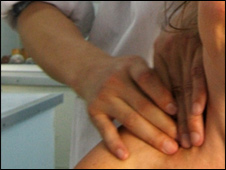
Mothers stroke their children, monkeys groom group members, and we all enjoy a massage, but what is it about stroking and rubbing that we find so enjoyable?

“People groom because it feels good,” said Professor Francis McGlone, a cognitive neuroscientist at Unilever R&D, but went on to explain that little is known about how we experience the pleasure of touch.

In order to isolate the touch-sensitive nerves responsible for the pleasure experienced during stroking, Professor McGlone designed a “rotary tactile stimulator” – a high-tech stroking machine.

“We have built some very sophisticated equipment, so the stimulus [of stroking] is very repeatable.

“We stroke the skin [of the forearm, foreleg, and face] with a brush at different velocities, and then asked the volunteers to rate how they liked it,” he explained.

He also inserted microelectrodes through the skin, into a nerve, to record the neural signals running from the skin to the brain.

“It is like tapping a single phone-line and listening for the chatter that comes down that line,” he told the conference.

Feel-good chemicals

By comparing how the neural signals corresponded with how much the volunteers enjoyed the stroking, he was able to pin down people’s pleasure to one set of nerves called “C-fibres”.

He thinks that the stroking movements are activating C-fibres, which are wired into the rewards systems in the brain, causing the release of feel-good hormones.

Professor McGlone points out that these touch nerves are not responsible for the pleasure experienced from rubbing sexual organs, nor are they found in a person’s palms or soles.

“Experiencing pleasure when grappling with tools or walking, would make both task difficult to do with any accuracy,” he suggested.

The Liverpool-based researcher showed that stroking speeds of about 5cm per second, while applying 2g of pressure per square cm is optimal, and gave the volunteers most pleasure.

He explained that the pleasure messages are conveyed from the skin to the brain, by similar types of nerve fibres as those that transmit the sensation of pain.

“This is interesting as we often rub a pain to try to alleviate it,” he said.

This could explain why the pain experienced by people exposed to a painful thermal stimulus, lessens when the region of the stimulus is simultaneously stroked.

Stroking could be used to treat chronic pain, he suggests.

:: Read original here ::
Fusion power seeks super steels

Scientists say an understanding of how the Twin Towers collapsed will help them develop the materials needed to build fusion reactors.
New research shows how steel will fail at high temperatures because of the magnetic properties of the metal.

The New York buildings fell when their steel backbones lost strength in the fires that followed the plane impacts.

Dr Sergei Dudarev told the British Association Science Festival that improved steels were now being sought.

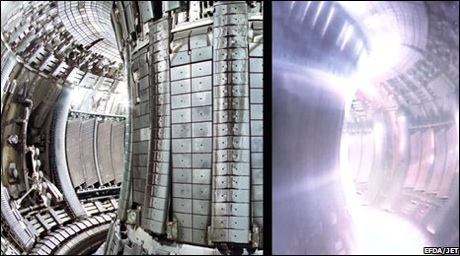
The principal scientist at the United Kingdom Atomic Energy Authority (UKAEA) said one of the first applications for these better performing metals would be in the wall linings of fusion reactors where temperatures would be in a similar range to those experienced in the Twin Towers’ fires.

‘Not melting’

The key advance is the understanding that, at high temperatures, tiny irregularities in a steel’s structure can disrupt its internal magnetic fields, making the rigid metal soft.

“Steels melt at about 1,510C, but lose strength at much lower temperatures,” explained Dr Sergei Dudarev, principal scientist at the United Kingdom Atomic Energy Authority (UKAEA).

Artist's impression: Atoms in steel (UKAEA)

Iron atoms in steel: Black balls show irregularities that disrupt magnetic fields, weakening steel

At room temperature, the magnetic fields between iron atoms remain regular, but when heated, these fields are altered allowing the atoms to slide past each other, weakening the steel.

“[The steel] becomes very soft. It is not melting but the effect is the same,” said Dr Dudarev.

He said blacksmiths had exploited this property for hundreds of years – it allows iron to become pliable at temperatures much lower than its melting point.

The peak in this pliability is at 911.5C, but begins at much lower temperatures, at around 500C – a temperature often reached during building fires.

The steel backbone of the Twin Towers was probably exposed to temperatures close to this, when insulating panels – meant to protect the buildings’ structural frame – were dislodged by the impacts of the hijacked planes.

The roaring fire mid-way up the building heated the steel struts, and once temperatures rose above 500C the structure became plastic, and collapsed under the force of the floors above.

Tuning up

The interest of Dr Dudarev and the UKAEA is to find steels that can withstand the intense heat of being inside a fusion reactor.

UKAEA has helped pioneer fusion power – deriving energy by forcing together atomic nuclei – at Europe’s JET lab in Oxfordshire; and is now assisting the development work on the world first large-scale experimental reactor known as Iter.

The extended periods over which Iter will run means the reactor must have robust materials built into the vessel where the fusion reactions will occur.

Dr Dudarev said it should be possible to tune the properties of suitable new steels by adding a mix of other elements.

“We need to look at the magnetic properties of steel, [and] vary their chemical composition in a systematic way in order to get rid of this behaviour,” he suggests.

:: Read original here ::

Foods ‘should label up eco-costs’

Food packaging could be embedded with computer chips that instantly link your phone to an on-line sustainable food guide, a UK conference has heard.

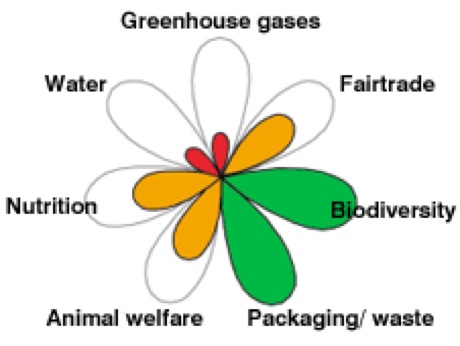
The guides would help consumers navigate their way through the ethical and ecological decisions about what they eat, the proponents argue.

The UK should lead Europe on this approach, food policy expert Professor Tim Lang said.

He was speaking at the British Association Science Festival.

Ethical impact

The criteria used to judge food sustainability are still up for debate.

“Do I eat green beans from Kenya, because they are good for me, or do I say no because there are four litres of water embedded in each stem of green bean?” asked Professor Lang, from City University, London.

He said scientists and policy-makers now realised the environmental, ethical, and health impacts of the food we ate.

Producers needed to find a way to present this information to the consumer, he told the conference.

He outlined a number of criteria that consumers should consider when buying food: how much energy and water are used to produce each calorie of food; what is the impact of the food item on climate, biodiversity, and the labour-force of the country it was grown in, and what are the health and financial costs of food.

Criteria agreement

“Packaging could be the point of entry for [this] information,” said Professor Lang.

Information on socio-economic and environmental criteria could be presented simply through “food flowers” – diagrams where each petal represents a different impact, with the shaded area of a petal showing how highly a food item scores.

The more detailed information could be accessed from a website and uploaded from food packaging to our mobile phones.

There would, however, need to be universal agreement on which issues should be reflected in the labels.

“That needs governments to agree with companies, to agree with civil society to agree what those criteria are,” explained Professor Lang.

:: Read original here ::

Ocean mission delivers first maps

Less than a month after it was put in orbit, the ocean-mapper Jason-2 has returned its first pictures to Earth.

From an altitude of more than 1,300km, the spacecraft is now feeding back data covering nearly the entire globe.

Jason-2 is set to become the primary means of measuring the shape of the world’s oceans, taking readings with an accuracy of better than 4cm.

The information will be crucial to our understanding of both sea level rise and changing ocean currents.

The satellite is now flying in tandem with its predecessor, Jason-1.

The spacecraft, only 55 seconds apart, are making simultaneous measurements of the oceans’ “hills” and “valleys”, to allow precise calibration of Jason-2’s instruments.

Jason-2 (CNES)

The Jason Ocean Surface Topography Mission is led by the US and France

With everything in line, data collected with every circumnavigation of the Earth will help weather and climate agencies make better forecasts.

Jason-2, built by Thales Alenia Space, represents the joint efforts of the US and French space agencies (Nasa and CNES), and the US and European organisations dedicated to studying weather and climate from orbit (Noaa and Eumetsat).

Its key instrument is the Poseidon 3 solid-state altimeter. It constantly bounces microwave pulses off the sea surface.

By timing how long the signal takes to make the return trip, it can determine sea surface height. Additionally, the signal can indicate the height of waves and wind speed.

Elevation is a critical parameter for oceanographers. Just as surface air pressure reveals what the atmosphere is doing above, so ocean height will betray details about the behaviour of water down below.

Jason data gives clues to temperature and salinity. When combined with gravity information, it will also indicate current direction and speed.

The Jason lineage shows that mean sea level has been rising by about 3mm a year since 1993.

Jason-1 will continue to operate for as long as it is returning reliable data.

:: Read original here ::

Geological mapping gets joined up

The world’s geologists have dug out their maps and are sticking them together to produce the first truly global resource of the world’s rocks.

The OneGeology project pools existing data about what lies under our feet and has made it available on the web.

Led by the British Geological Survey (BGS), the project involved geologists from 80 nations.

Between 60% and 70% of the Earth’s surface is now available down to the scale of 1:1,000,000.

“That’s 1cm for every 10km of the Earth’s surface,” explained Ian Jackson from the BGS and leader of the OneGeology Project.

“With that resolution, people can focus in on a small part of their city.

Geological globe (CGMW)

The project pools existing data on the world’s rocks

“Eventually, people will be able to get up close and see the rocks beneath their house.”

Mr Jackson said this was because the geological maps were being constantly updated.

“Every time someone bores a hole in the ground, and hauls out some rock, we can refine our maps a little bit more.”

Project organisers explained that what is novel about this project is that it takes local geological information and makes it global.

Useful rocks

The resource displays geological information with the use of a “virtual globe”, in much the same way as Google Earth now presents satellite images.

Eventually, it is hoped that the geological maps will be detailed enough to help companies find the Earth’s exploitable resources, such as minerals and oil.

Mr Jackson suggested that the project should encourage the mining of minerals in developing countries, by making maps available that were previously unavailable to outside investors.

The developers of the system added that it would also help scientists and engineers learn more about the Earth and its environmental changes.

“Rocks are not inert, they influence the supply of water and the formation of soil, and so impact flooding and agriculture.”

How low can you go?

Researchers at the BGS hope that by making geological surveys global, they can encourage “big science” – research that no one country or geological survey could do on its own.

By crossing national borders, the “joined-up geology” should foster international initiatives that will target global problems, such as climate change.

“Geological surveys across the world are involved in trying to work out how you put CO2 underground and keep it there, and these sorts of databases are going to be required.”

At present, most of the globe is available at the scale of 1:1,000,000.

“However, some nations take the view that 1:1,000,000 is too commercially sensitive to release,” conceded Mr Jackson.

“Other parts of the world have not been mapped thoroughly enough to give us the resolution we would like.”

The project is the first global geological map that is constantly updated, so the resolution will only get better. In France and Britain, users of the OneGeology resource can already look at the rocks that lie directly beneath their feet in 3D.

:: Read original here ::

Hungry seals ‘steer by the stars’

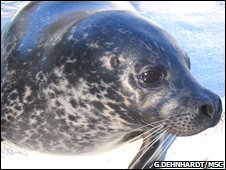
Seals can identify a single star in the night sky and navigate by it, scientists have discovered.
Navigating in the open ocean is essential for seals to move between foraging grounds that may be hundreds of kilometres apart.

This is the first evidence that marine mammals, like humans, use stars to navigate in open water, say scientists.

The European team has published details of its work in the journal Animal Cognition.

The researchers, headed by Dr Guido Dehnhardt of University of Rostock in Germany, simulated a night sky above two captive male seals and monitored the movements of the animals through six hidden infrared cameras.

“Initially, the seals were guided to one of the brighter stars by a laser pointer, and encouraged to swim towards it,” said Bjorn Mauck of the University of Southern Denmark and one of the team-members.

Wild Seals

Once the seals got the hang of navigating by the one star, the night sky above them was swivelled around and the seals were watched to see if they could still orientate themselves.

“With a little practice the seals swam in the right direction 100% of the time,” said Dr Mauck.

In the wild, seals’ foraging trips can take several days and so they often find themselves in open water with no visible landmarks for nights on end. How these wild seals learn the relationship between a star and their feeding ground is still unknown.

seal (G.Dehnhardt/MSC)

Hard work for captive seals used to study animal navigation

“Seals might learn the position of the stars relative to foraging grounds during dawn and dusk when they can see both the stars and landmarks at the coast,” suggests Dr Mauck.

The researchers think that marine mammals might use star paths, or “kaveingas” as Polynesian seafarers call them.

These people navigate by heading towards a star on the horizon until it moves too high to see, and then swap over to follow another star, and so on, guiding their way until dawn.

Seals, sealions and whales are often seen elevating themselves out of the water as they swim in open ocean. This act of coming out of the water vertically and staying above the surface momentarily, in the same way a human treads water, could allow marine mammals to set their course, the researchers speculate.

:: Read original here ::

World’s smallest snake discovered

_44884355_snake

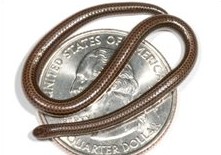
The world’s smallest snake, averaging just 10cm (4 inches) and as thin as a spaghetti noodle, has been discovered on the Caribbean island of Barbados.

The snake, found beneath a rock in a tiny fragment of threatened forest, is thought to be at the very limit of how small a snake can evolve to be.

Females produce only a single, massive egg – and the young hatch at half of their adult body weight.

This new discovery is described in the journal Zootaxa.

The snake – named Leptotyphlops carlae – is the smallest of the 3,100 known snake species and was uncovered by Dr Blair Hedges, a biologist from Penn State University, US.

“I was thrilled when I turned over that rock and found it,” Dr Hedges told BBC News.

“After finding the first one, we turned hundreds of other stones to find another one.”

In total, Dr Hedges and his herpetologist wife found only two females.

Defining species

Dr Hedges thinks that the snake eats termites and is endemic to this one Caribbean island. He said that, in fact, three very old specimens of this species were already in collections – one in London’s Natural History Museum and two in a museum in Martinique.

However, these specimens had been misidentified.

snake(b.hedges/psu)

The snake’s habitat is usually under rocks eating termites

Dr Hedges explained the difficulty in defining a new species when the organism is so small.

“Differences in small animals are much more subtle and so are frequently over-looked,” he said.

Modern genetic fingerprinting is often the only way to tell species apart.

“The great thing is that DNA is as different between two small snakes as it is between two large snakes, allowing us to see the differences that we can’t see by eye,” explained Dr Hedges.

Researchers believe that the snake – a type of thread snake – is so rare that it has survived un-noticed until now.

But with 95% of the island of Barbados now treeless, and the few fragments of forest seriously threatened, this new species of snake might become extinct only months after it was discovered.

Smallest of the small

In contrast to other species of snake – some of which can lay up to 100 eggs in a single clutch – the world’s smallest snake only produces a single egg.

“This is unusual for snakes but seems to be a feature of small animals,” Dr Hedges told BBC News.

By having a single egg at a time, the snake’s young are one-half the length of the adult.

Dr Hedges added that the snake’s size might limit the size of its clutch.

“If a tiny snake were to have more than one offspring, each egg would have to share the same space occupied by the one egg and so the two hatchlings would be half the normal size.”

The hatchlings might then be too small to find anything small enough to eat.

This has led the researchers to believe that the Barbadian snake is as small as a snake can evolve to be.

Snake sizes (PSU)
The smallest animals have young that are proportionately enormous relative to the size of the adults producing the offspring
As in the case of Leptotyphlops carlae, the hatchlings of the smallest snakes are one-half the length of an adult
The hatchlings of the biggest snakes on the other hand are only one-tenth the length of the adult producing the offspring
Tiny snakes produce only one massive egg – relative to the size of the mother. This is evolution at work, says Dr Hedges
The pressure of natural selection means the size of hatchlings cannot be smaller than a critical limit if they are to survive

:: Read original here ::

Elastic electronics see better

Electronics

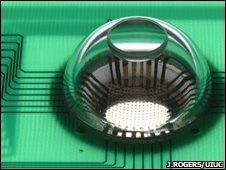
A new camera designed with a curved detection surface allows imaging devices to see as animals do.

The camera, inspired by the human eye, relies on the ability to construct silicon electronics on a stretchable membrane.

In the future, these electronic membranes could be wrapped around human organs to act as health monitoring devices, say US-based developers.

The new technology is described in a paper in the journal Nature.

Photosensitive displays – like the ones used in digital cameras – are made up of thousands of pixels and are usually formed on a flat, rigid, semiconductor wafer, explained Dr John Rogers from the University of Illinois at Urbana-Champaign, US, who led the team of researchers.

“No animal’s eyes are like that; the retina is curved,” Dr Rogers said.

“This curvature allows animals to see the world without distortion – unlike the images produced from cameras, which lose focus at the periphery.”

Hoping to improve digital imaging, the Illinois-based researcher and his team, joined up with a group of mechanical engineers from Northwestern University, to make a camera shaped more like an eye.

The challenge was to import the thin, brittle wafer-based camera technology to a curved surface. The result was a 2cm-wide camera with a single, simple lens and a concave light detection system.

Wafer-thin

The team approached the initial problem by dicing up the surface of the silicon wafer into “chiplets” – tiny pieces of silicon that detect incoming light.

Other

The technology could be used to make an advanced pacemaker

Then, the world’s smallest cables, only one micron thick – the equivalent of 1/100 of the thickness of a human hair – provided the electrical connections between the adjacent chiplets to make a circuit.

Dr Rogers explained that if you squeeze the circuit, the cables allow the chiplets to move relative to each other.

Next, the team developed a curved elastic membrane.

Dr Rogers said that they had grabbed the edges of the membrane, pulling it in all directions, until taut and flat. Then the researchers dropped the mesh-like circuit of “photoreceptors” onto its surface.

“We released the membrane, let it snap back and saw that it puts all the photosensitive chips into compression,” Dr Rogers said.

“The ribbons pop-up, forming bridges between the chiplets, and so maintain the electrical connections.”

Flexible imaging

He added: “The interconnected mesh allows you to stretch, deform and reshape the circuit of photoreceptors [giving you an undistorted image].”

This is the first time anyone has moved electronics off rigid semiconductor wafers on to a fully flexible surface. The applications for this “flexible, stretchable” technology are vast, Dr Rogers told BBC News.

The photoreceptors could be swapped for any other type of receptor, and the whole circuit integrated into the human body for health monitoring.

“Look at the human body; there is nothing rigid about it,” says Dr Rogers.

His team is already developing circuits that contain electrodes, housed in the same membrane, to wrap around portions of the brain in people suffering from epilepsy, to act as an early warning system for seizure.

This technology could also be used in the heart to emit tiny electrical signals, acting as a very advanced pacemaker.

:: Read original here ::

Ancient shark had colossal bite

Shark

The great white shark may have awesome jaws but they are nothing compared with those of megalodon, its gigantic, whale-eating ancestor.

A new study of the extinct creature’s skull shows it had an almighty bite, making the prehistoric fish one of the most fearsome predators of all time.

All the more remarkable, scientists say, because the crushing force came from jaws made of cartilage, not bone.

The researchers report their skull work in the Journal of Zoology.

The Carcharodon megalodon super-shark swam in the oceans more than a million-and-a-half years ago.

It grew up to 16m (52ft) in length and weighed in at 100 tonnes – 30 times heavier than the largest great white – and must have been one of the most formidable carnivores to have existed.

“Pound for pound, your common house cat can bite down harder, ” explained Dr Stephen Wroe of the University of New South Wales, Australia. “But the sheer size of the animal means that in absolute terms, it tops the scales.”

Measuring up

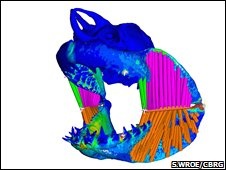
Dr Wroe’s team used a technique known as finite element analysis to compare the skulls of the great white with that of the prehistoric megalodon.

The approach is a common one in advanced design and manufacturing, and allows engineers to test the performance of load-bearing materials, such as the metal in the body and wings of an aeroplane.

CT (X-ray) scans were taken of megalodon remains to construct a high-resolution digital model.

A model of a modern 2.4m-long male great white shark (Carcharodon carcharias) was developed for comparison.

Artist's impression: Megalodon (BBC)

A recent BBC series imagined a face-to-face encounter

The model of Megalodon’s muscles was based on those of the great white, and the simulations were then loaded with forces to see how the two skulls, jaws, teeth and muscles would have coped with the mechanical stresses and strains experienced during feeding.

By looking at the distribution of stress and strain on the sharks’ jaws, researchers found that the largest great whites have a bite force of up to 1.8 tonnes, three times the biting force of an African lion and 20 times harder than a human bites.

Megalodon, though, is more impressive. It is estimated to bite down with a force of between 10.8 to 18.2 tonnes.

The team said biting with such force was quite a feat given that the jaws of these ancient creatures were made of flexible cartilage.

In contrast to most other fish, sharks’ skeletons are made up entirely of cartilage. Scientists think that cartilage, being a much lighter material than bone, is one adaptation that allows sharks to swim without the aid of a swim bladder.

With finesse

The Australian research team was interested in how a cartilaginous jaw performs compared with a bone jaw.

The scientists’ study shows that the cartilaginous jaw is almost as strong as a bony jaw of the same size – losing only a few percent – in measures of bite force. What is more, the elasticity of the cartilage jaw increases the gape of the sharks to devastating ends.

“The shark’s upper jaws can be dislocated: the whole upper and lower jaw pull out and forward as the shark twists and shakes its head from side to side to bite a chunk out of its prey,” explains Dr Wroe.

These sharks feed on very large prey: the great white shark eats sea lions and the megalodon is thought to have eaten whales.

“These sharks ambush their prey and immobilise them with a bite, then wait for them to die,” Dr Wroe told BBC News. “They are actually delicate feeders and take care not to damage their teeth by biting down too hard on the large bones of their prey.”

To keep their teeth sharp, sharks have a battery of them that is continually replaced.

It is the combination of their size, their razor-sharp teeth and the element of surprise that makes these sharks such deadly predators.

MEGALODON COMPARED WITH THE GREAT WHITE SHARK

Shark graphic
Megalodon Great white shark
Type Cartilaginous fish Cartilaginous fish
Size 16m (52ft) 6m (20ft)
Diet Whales, including the now extinct Odobenocetops, seals Fish, turtles, seals, sea lions, squid and crustaceans
Predators None known Occasionally caught by fishing industry as bycatch

:: Read original here ::