Swedish wolves threatened by under-reported poaching

Illegal poaching accounts for over half of all deaths of Swedish wolves, suggests a new study.

Basing their estimates on long-term wolf counts, the researchers reveal that two-thirds of poaching goes undetected.

The study suggests that without the past decade of persecution Swedish wolves would be four times more abundant than they are today.

The study’s findings are reported in Proceedings of the Royal Society B.

“Many have speculated that poaching levels are high for many threatened species of carnivores,” said Chris Carbone from the Zoological Society of London.

“This study presents an important step in trying to quantify this hidden threat,” he added.

The new study predicts the size of the wolf Swedish population each year based on counts from the previous year.

These counts are based on radio-tracked wolves and the more traditional ‘footprint count’, used in Sweden for over 10 years to estimate wolf numbers.

Counting canines

The researchers’ estimates took account of confirmed cases of wolf mortality – such as when a wolf is killed on the road, dies from disease or is found killed.

However, when the team, based at Grimso Wildlife Research Station in Sweden, compared the expected numbers produced by their models to the actual number of wolves in the wild, they found they were over estimating the size of the population.

Conservation biologist Guillaume Chapron, and one of the team, suspects that ‘cryptic poaching’, poaching that goes undetected, accounts for this difference.

The poaching we see is the “tip of the iceberg,” he said.

The researchers predict that without the last decade of poaching, wolves would have numbered around a thousand by 2009, four times the number reported that year.

Wolves are known to kill the dogs that many Swedes use to hunt moose, and despite up to four year prison sentence if caught poaching, a few people do not hestitate to take a shot at a wolf.

Founding fins

Poaching is not the only threat to the Swedish wolf.

These large carnivores went extinct in Sweden in the 1970s, and the population has since re-established itself after a handful of migratory Finnish wolves took over the empty territories.

Today, all 250 or so Swedish wolves have descended from these few founding individuals.

And so the population is highly inbred and suffers from skeletal abnormalities and problems reproducing.

Further reducing the number of wolves by poaching leaves this population very vulnerable to further inbreeding, explained Dr Chapron.

:: Read original here ::

Spermless mosquitoes hold promise to stop malaria

Scientists have created spermless mosquitoes in an effort to curb the spread of malaria.

Experts say that this is an important first step toward releasing sterile males into the wild to reduce the size of mosquito populations.

Malaria kills around one million people worldwide every year, and in Africa alone, accounts for 20% of all childhood deaths.

The work is reported in Proceedings of the National Academy of Sciences.

Insect sterilisation isn’t new: scientists have attempted to control the sleeping sickness-carrying tsetse fly by exposing them to radiation to render them sterile.

A similar approach has been successfully used against the potatoes weevil in Japan and the tropical screwworm that attacks cattle.

Frail fly

However, exposing mosquitoes to radiation has tended to leave male mosquitoes frail, and unable to compete in the frenzied mating aerobatics that Anopheles gambiae – the world’s most efficient malaria vector – enjoys.

Now scientists have developed an alternative route to mosquito sterility.

Entomologist Flaminia Catteruccia from Imperial College London enlisted the help of her graduate student Janis Thailayil in the search for how to make male mosquitoes sterile but leave them otherwise unharmed.

Mr Thailayil injected 10,000 mosquito embryos with tiny fragments of RNA designed to turn off a gene – called zpg – that is essential for normal sperm development.

After months of laborious work, the researchers created around 100 spermless mosquitoes, and showed that females were just as willing to mate with these males as with fertile ones.

Dr Catteruccia explains that female mosquitoes mate only once in their lives. If scientists can trick them into thinking that they have successfully mated, then they will continue to lay their eggs without knowing that they have not been fertilised.

“You [could] in principle release large numbers of sterile males over many generations… and eventually all the females will have mated with the sterile males and…you can really reduce the number of mosquitoes,” explained Dr Catteruccia.

This would gradually reduce the number of hatching mosquitoes. And hopefully help eradicate what many consider to be the single most dangerous insect species for mankind.

However, Dr Catterucci warns that this is only a proof of principle. The method her team used to create the spermless males would be far too labour-intensive to flood wild populations with enough spermless males to have any effect on their numbers.

However, knowing that females don’t notice whether they are receiving sperm or not is still an important step, she said.

:: Read original here ::

How bloodsuckers find their blood

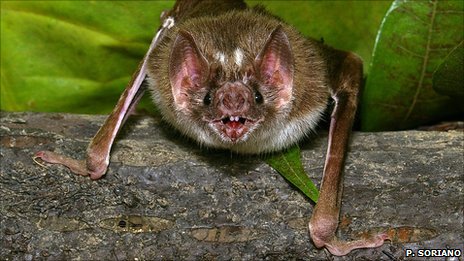
Scientists have identified the heat-sensitive facial nerves used by vampire bats to detect their next meal.

The nerves allow bats to pinpoint where the blood flows closest to their prey’s skin so they can feed more efficiently.

Vampire bats are among a handful of animals that use infrared sensors to locate their next meal, but are unique in the way they do it.

The findings are reported in the journal Nature.

Native to Central and South America, the Common Vampire Bat, Desmodus rotundus, needs to take a sanguineous slurp every night to survive.

Researchers believe that the bats rely solely on detecting their next meal in the dark by listening out for their prey’s breathing.

Having located a prey individual the bats crawls along the ground and onto the animal.

Once atop their prey, the bats are capable of using their heat-adapted nerves in their upper lip and nose to detect blood up to 20cm under their prey’s flesh.

The new finding has pinpointed the molecule that is responsible – heat-sensitive TRPV1. TRPV1, a protein, usually helps animals detect dangerously high temperatures (those over 43 degrees C), but in the bats, some of the TRPV1 molecules have been mutated into a version that is sensitive to lower temperatures, those around 30 degrees C.

Lots of blood-sucking animals search out their next meal using heat-detecting molecules, but they all seem to do it in a different way, said bat biologist, Brock Fenton from the University of Western Ontario, who was not involved in the work.

He said that perceptual world of bats undoubtedly has many more intriguing secrets.

  • The Common Vampire Bat (Desmodus rotundus) is one of three species of vampire bat: The Hairy-legged Vampire Bat (Diphylla ecaudata), and the White-winged Vampire Bat (Diaemus youngi)
  • All three live in the Central and South America
  • D. rotundus feeds mainly on domestic animals, using its razor sharp teeth to make small (5mm) cuts in their prey – most often around the neck or vulva – and secretes an anticoagulant into the wound so it can draw enough blood to the surface
  • D. rotundus drinks its body weight in blood each night, secreting blood plasma in its urine as it feeds to lighten the load
  • Scientists have developed a anti-clotting drug from the saliva of vampire bats that could help stroke patients

:: Read original here ::

Mothers of twins ‘have heavier single babies’

Single babies born to mothers of twins tend to be heavier, report scientists.

The report in the journal Biology Letters is based on a 40-year data set collected in The Gambia.

Mothers with twins were found to give birth to heavier babies, but the study found a similar trend even among single babies born before twins.

Twin pregnancies are risky for both mothers and offspring, and the study suggests heavier, healthier single children may offset those risks.

Worldwide only 13 in 1,000 babies are born a twin, although this rate is higher in developing countries.

Researchers interested in probing the twinning question further have had to rely on the few long-term data sets collected in parts of the world where birth rates are higher, and there are therefore more twinning events.

Evolutionary biologist Ian Rickard from the University of Sheffield in the UK, saw an opportunity to do just this when he learned of a long-term data set from The Gambia, which included not only birth weights of about 1,900 babies born to around 700 mothers, but also the number of twins.

Analysing all 40 years, Dr Rickard explained that he and his Gambian and London-based colleagues saw that women who produced twins gave birth to heavier non-twin babies.

Harvesting data

The exact differences, however, depended on when those single babies were born.

The Gambia experiences regular variations in food supply, from a “harvest season” between January and June, and a “hungry season” for the rest of the year.

Single babies born during the harvest season before twins were on average 226g heavier than those from non-twinned families; those born after the twins were 134g heavier.

However, single children born into twinned families in the hungry season showed no discernible difference in average weight from those of non-twinned families.

“We’ve known for quite a while that… if a [foetus] is exposed to a period of the year between about July and October during their third trimester, they tend to have lower birth weight,” said Dr Rickard.

The assumption is that the stress of food scarcity swamps the heavier-baby effect found in the harvest season.

Producing twins, Dr Rickard suggested, could be just a by-product of natural selection acting on birth weight.

However, he stressed the “importance of replicating this [finding] in another population to see if this pattern holds up”.

He suspects that a hormone called IGF, which has long been linked to birth weight in humans, could be responsible for this pattern.

IGF is known to influence the growth rate of foetuses, and is implicated in the “polyovulation” that leads to multiple births.

In cattle, IGF levels tend to be 1.5 times higher in the cows who give birth to twins, and in mice high levels of the hormone are linked to larger litters.

:: Read original here ::

Dyslexia makes voices hard to discern, study finds

People with dyslexia struggle to recognise familiar voices, scientists suggest.

The finding is the first tentative evidence that small sounds in the human voice that vary between people are difficult for dyslexics to hear.

Writing in the journal Science, the scientists say that many people could have some degree of “voice blindness”.

And by studying it, scientists hope to better understand how the human brain has evolved to recognise speech.

Humans rely on small sounds called phonemes to tell one person from another.

As we first try to form the word dog, for example, phonemes are the “duh”-“og”-“guh” sounds that our parents prompt us to make.

But as we master the ability to read, we become less reliant on recognising these sounds to read, and eventually stop noticing them.

Despite ignoring them, however, phonemes remain important for voice recognition.

The tiny inflections in the way people pronounce phonemes gives a listener cues to tell one voice from another.

Because people who suffer from dyslexia are known to struggle with phonemes when reading, a US-based team of scientists wondered whether they might also struggle hearing them in people’s voices.

Listen well

To investigate, the team grouped 30 people of similar age, education and IQ into two camps: those with and without a history of dyslexia.

The subjects then went through a training period to learn to associate 10 different voices – half speaking English and half speaking Chinese – with 10 computer-generated avatars.

The subjects were then later quizzed on how many of those voices they could match to the avatars.

Non-dyslexics outperformed people with a history of dyslexia by 40% when listening to English.

However, this advantage disappeared when the groups were listening to Chinese.

Dorothy Bishop from the University of Oxford thinks that this is because “when [they] are listening to Chinese, it is a level playing field, because no one has learned to hear [Chinese] phonemes”.

The researchers think that dyslexics don’t have as comprehensive a phoneme sound library in their heads, and so they struggle when they hear phonemes spoken by unfamiliar voices because their “reference copy” isn’t as well-defined.

“It is a very interesting result. The only thing that I would really like to see to convince me… is if they were to repeat the experiment using Jabberwocky.”

Using Jabberwocky, the nonsense poem by Lewis Carroll, would allow the researchers to determine whether the listeners identify who’s who from the meaning of what they are saying, or whether listeners are purely relying on the phonemes.

Dr Bishop speculated that non-dyslexics may be worse at extracting the meaning of the words, meaning they under perform in this task.

Understanding the mechanics of voice recognition is important, said the study’s lead author Tyler Perrachione from the Massachusetts Institute of Technology in Cambridge, US, because it allows a listener to pinpoint a familiar voice above the hubbub of a crowded room.

Mr Perrachione explained that very little is known about voice blindness, which is formally called phonagnosia.

“In reality, phonagnosia is probably much more common,” he explained, “but people who don’t recognise that voices sound different may not even realise they lack the ability to tell voices apart.”


:: Read original here ::

Age-related brain shrinking is unique to humans

The brains of our closest relatives, unlike our own, do not shrink with age.

The findings suggest that humans are more vulnerable than chimpanzees to age-related diseases because we live relatively longer.

Our longer lifespan is probably an adaptation to having bigger brains, the team suggests in their Proceedings of the National Academy of Sciences paper.

Old age, the results indicate, has evolved to help meet the demands of raising smarter babies.

As we age, our brains get lighter. By 80, the average human brain has lost 15% of its original weight.

People suffering with age-related dementias, such as Alzheimer’s, experience even more shrinkage.

This weight loss is associated with a decline in the delicate finger-like structures of neurons, and in the connections between them.

Alongside this slow decline in its fabric, the brain’s ability to process thoughts and memories and signal to the rest of the body seems to diminish.

Researchers know that certain areas of the brain seem to fare worse; the cerebral cortex, which is involved in higher order thinking, experiences more shrinkage than the cerebellum, which is in charge of motor control.

Yet despite the universality of ageing, scientists do not fully understand why our brains experience this continuous loss of grey matter with age.

Intriguingly, the brains of monkeys do not seem to undergo the same weight loss, raising the question of whether it is a distinctively human condition.

Now, a team of neuroscientists, anthropologists, and primatologists have pooled their expertise and datasets to reveal the answer.

Comparing magnetic resonance images from more than 80 healthy humans between the ages of 22 and 88 with those of a similar number of captive-bred chimps, the researchers found that chimps’ brains do not shrink with age.

The results suggest that the estimated 5-8 million years of evolutionary history that separate chimps from humans have made all the difference in the way that the species age.

It takes a village…

Anthropologist Chet Sherwood from George Washington University in Washington DC, who led the study, thinks that humans live longer to “pay for” their larger-brained children.

Humans live relatively long compared to other great apes. The majority of this extended life is post-menopausal, while chimps are reproductively viable right up to their death.

A human brain is three times the size of chimpanzee’s.

And it is not such a stretch, Dr Sherwood suggests, to conclude that grandparents’ extended lives are in an evolutionary sense there to relieve mothers from being solely responsible for raising their big-brained, energetically costly infants.

“I say this right now, as my seven year old daughter is being looked after by my mother,” he told BBC News.

“Because neurons cannot regenerate, aging, he thinks, is just the stress of living long enough to lend a helping hand to some relatives.”

“[The study] provides very good evidence that the patterns of brain ageing in humans are quite different from other animals,” commented neuroscientist Tom Preuss from Emory University in Atlanta, US, who was not involved in the research.

However, Dr Preuss was clear that these differences do not make other animals useless as models for studying age-related diseases.

Instead, the differences could help to explain why humans suffer more from these diseases than other animals seem to.

:: Read original here ::

Tasmanian devil genome holds secret to survival

Scientists have sequenced the complete genomes of two Tasmanian devils in the hope of finding clues to preserving this highly endangered marsupial.

Devil populations have been decimated by a highly contagious facial cancer that is transferred when these aggressive animals bite each other.

The findings will help researchers select the best individuals to be kept in captivity for eventual re-release.

The research is outlined in Proceedings of the National Academy of Sciences.

The Tasmanian devil, Sarcophilus harrisii, gets its name from its high-pitch, blood-curdling squeal, and is renowned for fighting over access to animal carcases, which it grinds with the bone-crushing force of its jaws.

Candid cancer

In 1996, a wildlife photographer snapped an image of an animal in the far north-east of Tasmania with a peculiar growth on its face.

The growth, it turned out, was neither benign, nor isolated to this one individual, but was a highly contagious, fatal cancer that seemed to be spreading through the population at lightning speed.

By 2007, conservationists reported that Devil Facial Tumour Disease, DFTD, had wiped out more than 90% of devil populations in the north-east of Tasmania, and was spreading west.A strategy to save the devil from extinction was begun.

Now, an international team of genomicists is offering a helping hand.

The researchers took advantage of the latest technology to read the genetic sequence of two devils – an uninfected male called Cedric, and an infected female called Spirit – along with smaller segments of DNA from 175 other individuals.

The team hopes to use the genomes to pinpoint which individuals should be placed into “protective custody” to wait out the cancerous epidemic before being reintroduced.

From their analysis, the scientists predicted how best to capture as much genetic diversity among the individuals put aside for captive breeding, explained lead author Webb Miller, a genomicist from Pennsylvania State University, US.

He said that choosing individuals who were very genetically dissimilar should take priority over whether they were resistant to the cancer.

The devil you know

“It is a big step forward to actually get the genome sequence from this animal… the [world’s largest] remaining carnivorous marsupial,” said zoologist David Rollinson from the Natural History Museum, UK.

Getting two complete genomes was very valuable, said Dr Rollinson, but getting as many samples as they did, from as many different animals was “just the icing on the cake”.

Dr Rollinson thinks that a similar approach could be used to study and save other endangered animals.

The researchers also sequenced one of the five tumours from Spirit’s head for clues to why the Tasmanian devils fail to recognise the cancer as “non-self”, and destroy it before it takes hold.

Understanding what it is about the devil’s immune system that makes it so ineffectual at picking up the facial cancer will not only help treat those already infected, but will hold clues about whether the cancer can jump species.

“The greatest worry is that it will jump into another marsupial,” said cancer geneticist Elizabeth Murchison from the Welcome Trust Sanger Institute in Hinxton, UK.

The transmissible facial cancer

  • Devil Facial Tumour Disease (DFTD) is spread by biting during aggressive encounters
  • The living cancer cells exist as a contagious clone; highly unusual for a cancer. In fact, there is only one other transmissible cancer known, which infects dogs’ genitals
  • The devil’s immune system seems unable to detect the cancer
  • The disease forms tumours around the mouth interfering with feeding leading to death
  • The cancer originally arose in Schwann cells – cells which wrap themselves around nerve tissue
  • First seen in 1996, the cancer has since decimated devil populations

:: Read original here or listen to me talk about the results on the BBC’s Science in Action.

A rare he-she butterfly is born in London’s NHM

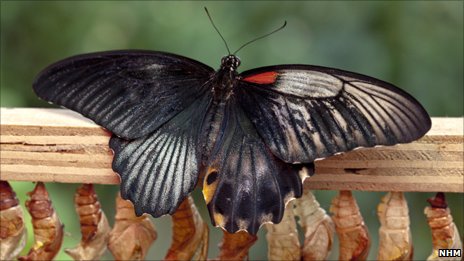
A half-male, half-female butterfly has hatched at London’s Natural History Museum.

A line down the insect’s middle marks the division between its male side and its more colourful female side.

Failure of the butterfly’s sex chromosomes to separate during fertilisation is behind this rare sexual chimera.

Once it has lived out its month-long life, the butterfly will join the museum’s collection.

Only 0.01% of hatching butterflies are gynandromorphs; the technical term for these strange asymmetrical creatures.

“So you can understand why I was bouncing off of the walls when I learned that… [it] had emerged in the puparium,” said butterfly enthusiast Luke Brown from London’s Natural History Museum.

Mr Brown built his first butterfly house when he was seven, and has hatched out over 300 thousand butterflies; this is only his third gynandromorph.

Half and half

It is not only the wings that are affected, he explained. The butterfly’s body is split in two, its sexual organs are half and half, and even its antennae are different lengths.

“It is a complete split; part-male, part-female… welded together inside,” he told the BBC.

The dual-sex butterfly is an example of a Great Mormon, Papilio memnon –a species that is native to Asia.

With a shortage of butterfly-specific gender neutral pronouns, the butterfly is being referred to as “it”, and is already middle-aged at three and a half week’s old.

So the public has only a narrow window of opportunity to see it alive.

Though rare, gynandromorphy isn’t unique to butterflies; individual crabs, lobsters, spiders and chickens have all been found with a mix of two sexes.

There are likely many more cases in the natural world, but sexual chimeras are more difficult to spot in animals where females and males look alike.

:: Read original here ::

Over-fished tuna in ‘hot water’, study finds

Two more species of tuna have been added to the Red List of Threatened Species.

They join the Southern bluefin tuna – listed as critically endangered.

The report, published in this week’s Science, is the first global assessment of this highly prized family of fish, which are at risk of being over-fished.

The World Conservation Union (IUCN) says there is a lack of resolve to protect against overexploitation driven by high prices.

Until this latest study, attempts to assess the health of scombrid and billfish populations, families of fish that include tuna and swordfish, have been carried out at a regional scale.

This study, which relies on the IUCN Red List criteria to judge the stocks’ health, took a more global approach.

Of the 61 species of fish assessed, seven were earmarked as either vulnerable, endangered or critically endangered. All suffer from over-fishing, habitat loss and pollution.

Along with the two species of tuna, two mackerel and two marlin joined the Red List.

The ‘sapphires of seafood’

Per kilo, bluefins are among the most expensive seafood in the world.

“All three bluefin tuna species are susceptible to collapse under continued excessive fishing pressure. The Southern bluefin has already essentially crashed, with little hope of recovery,” said one the the study’s authors Kent Carpenter the IUCN’s Marine Biodiversity manager.

Southern bluefin numbers have reached levels that are one twentieth of those recorded before industrial fishing began.

Atlantic bluefins have probably gone the same way, add the authors, while bigeye tuna is labelled “vulnerable”.

“Tunas are highly migratory fish, swimming across ocean basins and between the waters of various countries during their lifetimes. Conserving them requires regional and global co-operation,” commented Susan Lieberman, director of international policy with the Pew Environment Group in a statement.

What is more, tuna’s restricted spawning grounds make them exceptionally susceptible to collapse if over-fishing continues, reports the international team of scientists.

And tuna’s long lifespan means it would take their population several years to recover if fishing stopped altogether.

Pew’s Dr Lieberman adds: “The IUCN Red List assessment reinforces that it is time for governments to live up to their responsibilities.”

The report comes days before the tuna regional fisheries management organizations (RFMOs) assemble in in La Jolla, California for the Kobe III meeting.

Read original here

And a little extra comment on the story.