Mars ‘remains in embryonic state’

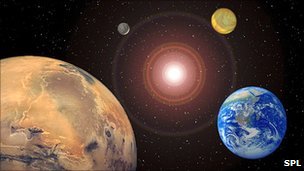
Mars formed in record time, growing to its present size in a mere three million years, more quickly than scientists previously thought.

Its rapid formation could explain why the Red Planet is about one tenth the mass of Earth.

The study supports a 20-year-old theory that Mars remained small because it avoided collisions with planetary building material.

The new finding is published in the journal Nature.

In our early Solar System, well before planets had formed, a frisbee-shaped cloud of gas and dust encircled the Sun.

Scientists believe that the planets grew from material pulled together by electrostatic charges – the same force that’s behind the “dust bunnies” under your bed.

These proto-planetary dust balls grew and grew until they formed what scientists term “embryo” planets.

These rocky masses were large enough to exert a considerable gravitational force on surrounding material, including other nascent planets.

Nudging each other with their gravitational fields, the embryos were often thrown from their regular orbits, sometimes into the path of another large rocky mass.

If collisions occurred, these nascent planets were either expelled from the Solar System or shattered into pieces. These pieces were often combined to form a larger planet. In fact, the Earth’s Moon is thought to be the result of an embryo planet colliding with our own planet.

By modelling this process, astro-physicists can determine the size of planets they expect to form at a given distance from the Sun. Mars is an outlier; it should have grown to around the size of the Earth, but remains about one-tenth its size.

Because of Mars’ small size, many scientists have long suspected that the Red Planet avoided the collisions that allowed other neighbouring planets to increase their girth.

Red Runt

By studying the chemical composition of meteorites, geochemist Dr Nicholas Dauphas of the University of Chicago in Illinois and Dr Ali Pourmand of the University of Miami in Florida joined forces to try to confirm this.

By measuring the concentration of elements Thorium and Hafnium in 44 space-rocks Dr Pourmand and Dauphas have come up with the most precise estimate of the time it took Mars to form.

Between 2 and 3 million years they suspect; short compared to the Earth, which is thought to have taken tens of millions of years to grow to its current size.

“We were pleasantly surprised because now we have precise evidence in support of the idea… that Mars is a stranded planetary embryo”, Dr Pourmand told BBC News.

He thinks that Mars was around more or less in its current size when the Earth was beginning to form.

Given this, Mars could not have experienced the same type of growth as the Earth and Venus, says Dr Pourmand.

It’s likely that Mars remains small because it deftly avoided colliding with other planets.

“The fact that Mars appears to have been left unscathed could just be down to luck,” says astrophysicist Dr Duncan Forgan of the University of Edinburgh, UK.

He explains that while it is unlikely that a planet could escape collisions for such long periods, statistically one expects it to happen from time to time.

When modelling planetary dynamics, researchers find it easier to predict what happens in general, he says, but it is much more difficult to determine what happens in specific solar systems, or in specific cases like Mars.

:: Read original here ::

Early rocks to reveal their ages

Rock2

A new technique has been helping scientists piece together how the Earth’s continents were arranged 2.5 billion years ago.

The novel method allows scientists to recover rare minerals from rocks.

By analysing the composition of these minerals, researchers can precisely date ancient volcanic rocks for the first time.

By aligning rocks that have a similar age and orientation, the early landmasses can be pieced together.

This will aid the discovery of rocks rich in ore and oil deposits, say the scientists. The approach has already shown that Canada once bordered Zimbabwe, helping the mining industry identify new areas for exploration.

Dr Wouter Bleeker, from the Geological Survey of Canada, explained that much of the geology that exists today formed around 300 million years ago when the supercontinent Pangea existed.

“We really don’t understand the [Earth’s] history prior to Pangea,” he told a recent meeting of the American Geophysical Union in Toronto.

Early landmasses

Analysis of rocks that formed when continents drifted apart can help geologists reconstruct early landmasses.

Dr Richard Ernst, a geologist from the University of Ottawa, explained that molten magma fills the cracks formed by shifting continental plates.

The magma cools to form long veins of basalt – a volcanic rock – that has a “distinct magnetic signature” revealing the rock’s orientation and latitude when it formed.

By combining this “magnetic signature” with the ages of these rocks, researchers can tell whether rocks on different continents were once part of the same volcanic up-welling.

But until now, researchers have been unable to determine the ages of many of these ancient rocks because of the difficulty in extracting the minerals used to date them.

“We are dealing with such small mineral crystals – typically much less than 100 microns long – we are talking about grains far smaller than the width of a human hair,” explained Dr Michael Hamilton, a geologist and co-leader on the project.

But with the development of new techniques, minerals – such as baddeleyite – can now be successfully recovered.

Baddeleyite is useful because it incorporates large amounts of uranium into its crystal-structure, and because uranium naturally decays to lead. Scientists also know the rate at which this happens.

“[They] can use these minerals as radioactive clocks,” Dr Hamilton added.

“All we need to do is measure the the amounts of uranium and lead very precisely.”

In a large, international project, researchers hope to collect and date 250 rocks from around the world, and use this information to reconstruct how these continental fragments were once together to form giant landmasses that existed 2.5 billion years ago.

:: Read original here ::

Space storm’s ‘epicentre’ found

Solar

The precise spot at which a space storm struck the Earth’s outer atmosphere has been pinpointed for the first time.

These storms are caused by the bending and stretching of the Earth’s magnetic field by material from the Sun.

Observations like this may one day lead to better forecasting of these events, a meeting of the American Geophysical Union in Toronto, Canada, has heard.

This would provide more time to power down satellites and electrical grids, which can be damaged by these storms.

“If we can start to understand when and why these space storms occur, then we can try to move from short-term forecasting to long-term forecasting,” Dr Jonathan Rae, from the University of Alberta, told BBC News.

Space storms are the result of billions of tonnes of material thrown into space by the Sun in great plumes.

These plumes stretch the planet’s magnetic field like an elastic band, distorting the field from its usual circular shape to a long ellipse that reaches out behind our planet.

Eventually, when the field can stretch no further, it snaps back into place, rocketing particles into the Earth’s upper atmosphere. This causes the auroral displays known as the northern and southern lights.

It also floods the space in the planet’s immediate vicinity with radiation at such huge levels that they would endanger the lives of astronauts. This process also generates electrical surges on the ground capable of disrupting a country’s power grid.

Dr Rae led a team of scientists who took measurements of changes in the Earth’s magnetic fields using a system of cameras and magnetic instruments on the ground, while simultaneously observing the onset of a space storm from Nasa’s five-strong fleet of THEMIS spacecraft.

They saw magnetic oscillations hit the upper atmosphere in a particular location – somewhere over Canada – and ripple out across the ionosphere. These events were followed, three minutes later, by an auroral display.

Researchers hope to use these observations to better predict these events. This could lead to the forecasting of storms hours, or even days, before they occur.

This would give more advanced warnings, helping protect humans and equipment from the radiation generated by disturbances.

“In the future, we should be able to predict space weather in the same way that we now can predict long-term weather forecasts [on Earth],” Dr Rae said.

Space storms are expected to increase as the Sun approaches another solar maximum. This is predicted to occur again by 2013 – when the influence of the Sun on the Earth’s magnetic field will be greatest.

The work is reported in the Journal of Geophysical Research and is co-funded by the Canadian Space Agency and Nasa.

:: Read original here ::

Space rock yields carbon bounty

Formic acid, a molecule implicated in the origins of life, has been found at record levels on a meteorite that fell into a Canadian lake in 2000.
Cold temperatures on Tagish Lake prevented the volatile chemical from dissipating quickly.

An analysis showed four times more formic acid in the fragments than has been recorded on previous meteorites.

The researchers told a meeting of the American Geophysical Union that the formic acid was extraterrestrial.

Formic acid is one of a group of compounds dubbed “organics”, because they are rich in carbon.

“We are lucky that the meteorite was untouched by humans hands, avoiding contamination by organic compounds that we have on our fingers,” said Dr Christopher Herd, the curator of the University of Alberta’s meteorite collection.

Samples of the meteorite totalling 850 grams were collected from Tagish Lake in Canada, purchased in 2006 by a consortium including the Royal Ontario Museum and recently subjected to chemical analysis.

The scientists found levels of formic acid four times higher than had previously been recorded on a meteorite. Studies have until recently focused on the Murchison meteorite that landed in a town of that name in Australia in 1969.

“The interesting thing is that we do see this variability between meteorites, seeming to have increased enrichments of one particular compound over another,” said Mark Sephton, a meteorite and geochemistry professor at Imperial College London.

“This has for a while been overlooked as we concentrated predominantly on the Murchison meteorite, but now we’ve got another fresh sample and we can start to analyse a different portion of the asteroid belt and therefore a different portion of the Solar System.”

Primordial kitchen

The particular types, or isotopes, of hydrogen that are found in the formic acid show that it most likely formed in the cold regions of space before our Solar System existed.

On Earth, formic acid is commonly found in the stings of insects such as ants, but Professor Sephton said it is likely to have been an important “ingredient in the kitchen” on Earth before life began.

The acid is known to act as a “reducing agent” – acting as a magnet for oxygen atoms during chemical reactions – and facilitate the conversion of some amino acids into others.

It may also be implicated in the transformation of the more primitive RNA into DNA.

Only one of the four “nucleobases” that make up RNA and DNA is different between the two: uracil is present in RNA while thymine takes its place in DNA.

Professor Sephton’s team found uracil in the Murchison meteorite, but no measurable amount of thymine. However, formic acid is known to help along the reaction that converts the uracil into thymine.

The reaction, he said, is “one of the ways in which you can take some simple molecules and increase the chemical diversity of the pool of pre-biotic molecules”.

:: Read original here ::

A Musical Memory Tour

For many of us, songs by the Beatles trigger vivid and specific memories. What’s going on in our brains when this happens and what makes a tune ‘catchy’? In this show, we go on a musical memory tour to the famous Cavern Club, successor to the Beatles’ first venue, to find the links between memory and music.

:: Listen here ::

Facial Recognition

How do we recognise faces and are there different ways of doing it in different parts of the World? I researched a piece for BBC Radio Four’s Material World.

:: Listen here ::

Sound Masking

How has the brain evolved to cope in a noisy world? I investigate how the brain overcomes the problem of sound masking for BBC World Service’s Science in Action.

:: Listen here ::

Canadian dig yields tiny dinosaur

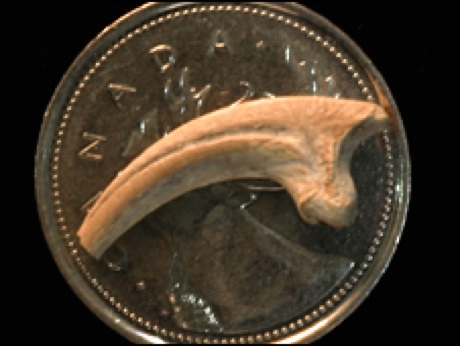
The smallest meat-eating dinosaur yet to be found in North America has been identified from six tiny pelvic bones.

Hesperonychus was the size of a small chicken, and used its rows of serrated teeth to feed on insects, experts say.

The bird-like creature is closely related to Microraptor – a tiny feathered dinosaur discovered in China.

The specimen helps to confirm that reptiles, and not mammals, filled the role of small predators during the age of the dinosaurs.

The fossil skeleton, which lay misidentified for 25 years as a lizard, belongs to a group of dinosaurs called the theropods – bipedal reptiles that eventually gave rise to birds.

“Despite the discovery of exquisitely preserved skeletons of small bird-like dinosaurs in Asia, they are exceedingly rare in North America,” explained Dr Philip Currie, a palaeontologist from the University of Alberta and co-author on the paper.

Dr Currie had been pondering why so few small fossils have been unearthed in Alberta, Canada – one of the world’s richest sites for large-dinosaur bones.

Infographic (BBC)


He suspected that small dinosaurs did not preserve well in the region of the prevalence of larger predators in the area.

“There were many large dinosaurs running around eating them, and small bones are easily washed away by rivers [common in this region during the Cretaceous period]”, Dr Currie said.

The new find casts more doubt on whether mammals would have acted as small predators in Cretaceous-era North America. The fossilised pelvis came from an animal that weighed no more than 1.9kg (4.2lb) and appears distinctively reptilian.

“This tells us that [as in Asia], North American dinosaurs likely out-competed mammals for both large and small predator niches,” Dr Currie told BBC News.

‘Tree-hugging raptor’

The authors also suggest this discovery helps to resolve debate over whether flight originated from animals that ran on the ground, flapping their arms, or whether it started with tree-climbing animals gliding downwards.

Based on the size of the hips, and because one of the hip bones was bent – the pubis, a small bone that sits between the legs – “we know this dinosaur was a tree-climber”, Dr Currie explained.

“It likely used the long feathers on its limbs to glide or parachute from tree to tree.”

The specimen, Hesperonychus elizabethae – named after its collector Dr Elizabeth Nicholls – was reclassified by palaeontolgist Dr Nicholas Longrich, a co-author of the paper, from the University of Calgary.

The findings were reported in a recent article in the journal Proceedings of National Academy of Sciences.

:: Read original here ::

Beatles’ tunes aid memory recall

The world’s largest catalogue of Beatles-related recollections will be unveiled in Liverpool this week.

The 3,000 memories, from 69 nations, could help scientists better understand how music can help humans tap into the long forgotten events of their lives.

A link between positive feelings and music could explain why tunes trigger memories, suggests the UK-based team.

The study is ongoing, and people can add their Beatles-related memory by visiting www.magicalmemorytour.com.

“For a long time people have noticed that music can help people remember events from their lives, [but] this is the first real data that shows this,” said Dr Catriona Morrison, a cognitive psychologist from the University of Leeds.

Preliminary results from the study, devised by Dr Morrison and her colleague Professor Martin Conway, are being presented to the British Association Science Festival.

Happy times

The research explores the vast repertoire of human autobiographical memories.

“[Autobiographical] memories are formed from the events of our lives; we need them in order to have a sense of self,” the Leeds-based team explained.

The researchers invited people to recount a memory that relates to the Beatles. Participants were told to think of the first thing that came to mind – a vivid memory relating to a particular album, song, news story or even a band member.

The study found that the recounted memories are almost always positive, that people remember particular episodes very vividly – sounds, smells and sights of the memory were often recounted.

“The memories were equally split between men and women, and came from all ages – the youngest was 17 and the eldest was 87,” Dr Conway told BBC News.

He explains that what he finds interesting is that there was no difference between men and women in terms of the sense of emotion that the memories evoked.

Dr Morrison explained that it was assumed that a failure to retrieve a memory was the result of that memory not being recorded properly in the first place. The fact that music cues long-forgotten events suggests the problem is not so much with storage as with retrieval, the researcher argued.

Whether certain types of music (or certain songs) can act as better aids for remembering the past remains unclear. But in a world where the UN predicts that by 2010, one in five people will be over 60, and failing memory is likely to become an important challenge for society, more rigorous research into the link between music and memory is much needed, says the team.

:: Read original heres ::